

DEAR READER: If independent journalism matters to you, please consider a $5/month membership. I report daily from inside Ukraine’s war — through blackouts, through attacks — and your support makes that possible. These dispatches will remain free to all readers. This work depends on those willing to sustain it, and I’m grateful to everyone who does. — Chris Sampson, Kyiv, June 24, 2026, Day 1581 of full scale Russian war against Ukraine.
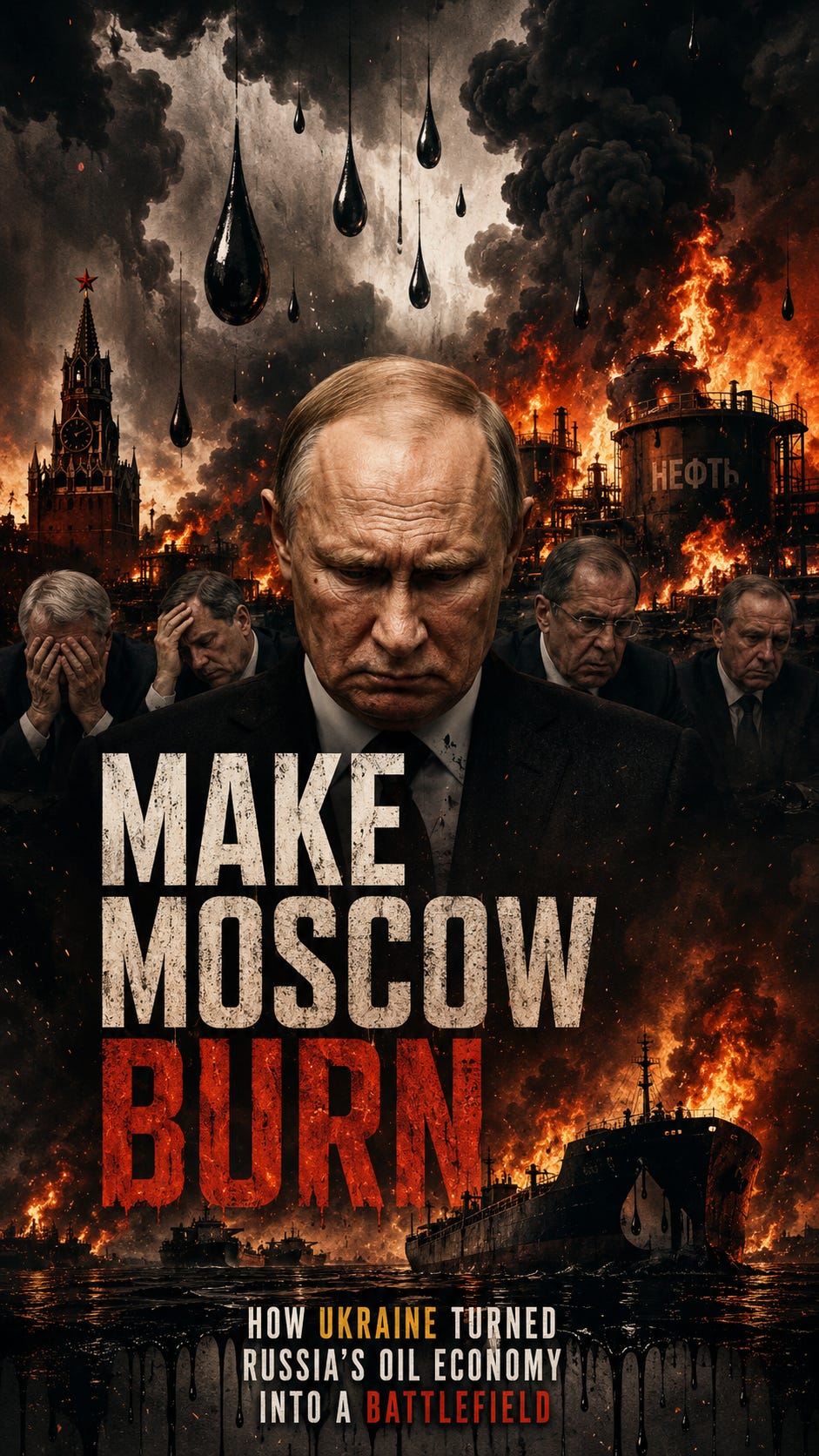
For most of this war’s first two years, an explosion inside Russia generated weeks of speculation rather than confirmation. A depot fire in Belgorod would draw competing theories about who was responsible and how.
Ukraine’s official channels stayed silent. Russian state media offered explanations that rarely survived scrutiny. Outside observers were left to guess.
We had a joke for it in Kyiv back then: “man with a cigarette.” Something blows up eleven hundred kilometers from any front line, the cause is always under investigation, and somewhere in there, presumably, is a man with a cigarette who got unlucky near something flammable. Nobody believed it. That was the point. The joke existed because Ukraine wasn’t claiming anything, and “man with a cigarette” filled the silence better than waiting for an answer that wasn’t coming.
That pattern held through 2022 and most of 2023.
It did not hold for long after that. By 2025, a refinery fire eleven hundred kilometers inside Russia was logged in a routine General Staff bulletin rather than treated as exceptional. And by June 2026, Moscow itself — the city Russia’s own propaganda had spent a decade insisting was untouchable, ringed by what state media described as the most sophisticated air defense network on the planet — was closing its airports because Ukrainian drones kept finding their way to a single oil refinery on its southeastern edge.
That is the story this piece is actually about. Not which target burned on which date. The myth that burned with it.
Russia invaded Ukraine in February 2022 on the assumption that the war would stay where it started. Ukrainian cities would absorb the consequences. Russian cities would remain comfortably elsewhere, untouched, immune, sanctuary.
For most of the first two years, that assumption mostly held — not because Ukraine lacked the will to test it, but because it lacked, in any sustained way, the reach. What’s happened since is the slow, then sudden, collapse of that sanctuary. Not as a single dramatic event but as the accumulated weight of a campaign built around a deceptively simple idea: find the systems that keep the Russian war machine running, and spend however long it takes to learn how to reach them.
By the time Ukrainian drones set the Kapotnya refinery ablaze for the second time in a single week this June, Moscow’s mayor was admitting on Telegram that drones were “reaching” targets even as his own air-defense rings multiplied around the capital. Pantsir missile systems had gone up on the roof of a shopping center on Begovaya Street. Gas stations in the capital region were rationing fuel to twenty liters a car.
None of that happened because of one lucky strike. It happened because Ukraine spent four years building a machine for finding Russia’s vulnerabilities, and a separate machine for telling the world, increasingly loudly, when it found one.
This is the story of that machine, told by the systems it learned to break rather than the dates on which it broke them.

Chapter One: The Oil War
If you want to understand why Russia’s refineries became the single most frequently struck target category of this entire war, start with a fact that’s almost too simple to feel like insight: Russia’s military runs on oil, and so does Russia’s treasury.
Every tank, every truck, every helicopter that flies a sortie against a Ukrainian city needs refined fuel to do it. Every refined barrel that doesn’t make it to a Russian tank still represents revenue that, if exported instead, helps pay for the next one. Hit the refining sector and you are pulling on two threads of the same rope at once — the money and the fuel. That’s precisely why it became the campaign’s center of gravity rather than a side project.
There’s a historical echo here worth pausing on, because militaries have tried this kind of campaign before, and the lessons from last time explain a lot about how this one actually unfolded.
In August 1943, American bombers flew a single, audacious low-level raid against the Ploiești oil refineries in Romania — Operation Tidal Wave — hoping one decisive strike could cripple the fuel supply behind the entire German war machine. It didn’t work. The Allies lost fifty-three aircraft and roughly five hundred airmen in a single afternoon. The refineries were patched within weeks using thousands of mobilized forced laborers. Net Romanian fuel output was higher after the raid than before it.
The lesson the Allies eventually absorbed, and applied across 1944 in a sustained, repeated campaign against the entire German oil and synthetic-fuel network rather than one dramatic raid, was that isolated strikes against resilient infrastructure accomplish very little. Sustained, repeated strikes against the same facilities, combined with attacks on the transport links connecting them, do. By mid-1944, German synthetic fuel output had collapsed to under a quarter of its earlier levels, and the Luftwaffe spent the war’s final winter grounding aircraft for lack of gasoline rather than lack of pilots.
Ukraine appears to have absorbed roughly the same lesson, just compressed into its own learning curve rather than borrowed from a history book. The early refinery strikes, in 2024, were exactly what Tidal Wave was — single, occasional, unnamed, easy for Russia to repair and move past.
What changed by 2025 was repetition married to range. The Ryazan refinery — one of Russia’s five largest — wasn’t hit once. It was hit in January, again at the end of January, again in February, again in September, twice more in November, and again in December: six distinct, separately confirmed strikes against a single facility inside one year. Saratov’s refinery took four hits across the same stretch. The Tuapse refinery on the Black Sea coast was struck three times in barely two weeks that spring, hard enough to suggest Ukraine had decided that whatever Russia managed to repair in the gaps simply wasn’t going to be allowed to run long.
That’s the part a strike-by-strike accounting misses and a systems view catches immediately: this was never really about damaging a refinery. It was about denying Russia the one thing every damaged industrial facility desperately needs — enough uninterrupted operating time to fully recover before the next disruption arrives.
A refinery struck once a year can absorb the hit and move on. A refinery struck six times in twelve months never gets to finish repairing itself, and the financial and logistical cost of that compounds in ways a single strike never could.
The geographic reach told its own story. In February 2026, a Ukrainian strike reached the Ukhta refinery in the Komi Republic — 1,750 kilometers from the Ukrainian border, farther than the distance from Kyiv to Berlin, deep enough into Russia’s northern interior that there is, by definition, no front line anywhere near it. Weeks later, Perm, in the Urals — more than 1,500 kilometers out — took three separate hits inside two weeks.
By May, Ukrainian and Russian intelligence channels were both describing Novorossiysk’s Grushovaya depot and Sheskharis export terminal, struck together, as a hit on what Ukraine’s own military intelligence agency called “the heart of Russian oil exports.” That language tells you the target wasn’t chosen for its symbolism, but for the simple fact that a meaningful share of everything Russia ships out of the Black Sea by tanker passes through that one facility.
By the security service’s own year-end accounting for 2025, the cumulative campaign — refineries, depots, pumping stations, export terminals, all hit and re-hit across a widening map — had cut Russian oil exports by more than 30 percent and degraded the “shadow fleet” Moscow had built specifically to move sanctioned crude around Western enforcement. That’s the agency’s own number, and you should treat any wartime service’s assessment of its own success with appropriate skepticism.
But even discounted, a sustained two-year campaign against the entire supply chain — extraction, refining, storage, export — doesn’t need to be perfectly accurate in its self-assessment to represent a real and growing problem for a war economy that runs on exactly the revenue stream it’s degrading.
What makes that figure harder to dismiss is that Russia’s own military-analytical community arrived at a strikingly similar diagnosis, from the other side of the targeting line. Rybar, the milblogger channel that functions as the closest thing Russia has to an internally credible OSINT outlet, spent the back half of 2025 logging refinery strikes in its nightly chronicles as routine line items — confirmed, dated, no editorial spin, no aggregate framing.
The frustration only surfaced after Spiderweb, when the channel finally said what the chronicle format had been quietly documenting for months: “After losing Tu-95MS aircraft, colleagues again raised the question of arming tactical aircraft with long-range cruise missiles for strikes at strategic depth... With us the situation has barely changed... And this complacency produces only anger.”
By June 2026, Rybar’s own monthly assessment went further, conceding something no Ukrainian bulletin needed to claim on its behalf: Russia had reached peak crude exports for the year not despite the refinery campaign but partly because of it. Domestic processing capacity had been damaged badly enough that more crude was being shipped out raw, unrefined, rather than turned into the fuel the war machine actually needed at home. A hostile source had just confirmed, in its own words, that hitting the refineries was working exactly the way the campaign’s architects presumably hoped it would.
Chapter Two: The Bomber Hunt
Here is the thing about strategic bombers that should matter to anyone reading this from outside Ukraine: when a Tu-95 or a Tu-160 takes off from a Russian airbase loaded with cruise missiles, the people on the other end of that flight are not soldiers on a front line. They are civilians in Kyiv, in Kharkiv, in Odesa, asleep or awake in apartment buildings that have nothing to do with this war except the misfortune of being inside a Russian flight path.
Every strike on a bomber, every strike on the base it sits on, every strike on the missiles stockpiled beside it, has a more direct line back to a Ukrainian kitchen table than almost anything else in this entire campaign.
Engels, in Saratov Oblast, is where a meaningful share of those flights originate — home to Russia’s Tu-95 and Tu-160 fleets. On March 20, 2025, Ukrainian forces struck the part of the base identified as Engels-2, and a week later the follow-up confirmation didn’t traffic in vague language about fire and smoke. It gave a number: ninety-six air-launched cruise missiles destroyed on the ground. Missiles that were sitting fueled, mounted, ready, almost certainly destined for a city full of people who had no part in any of this — and instead burned on a runway in Saratov Oblast before they ever got the chance to fly.
This was not the first time Engels had been hit. The earlier strike — December 5, 2022 — produced a reaction from inside Russia’s own military-analytical community that’s worth reading in full, because it tells you something the Ukrainian bulletins never could: how the target actually registered on the other side.
Russia’s official channels called it minor. The Defense Ministry’s statement described “insignificant damage to the hull casing of two aircraft” and credited Russian forces with intercepting the drones, not failing to stop them.
Rybar, the country’s most-read military-analytical channel, said something else entirely, within hours, in language no state outlet would touch: “Strategic aviation — nuclear-armed Kh-55 and Kh-102 cruise missiles on the Tu-160/95 — is a component of the nuclear triad alongside intercontinental ballistic missiles... Today’s sabotage equals an attack on a strategic submarine base, or hangars holding Yars missiles.”
A separate post the same morning went further, reading less like military analysis than something closer to a confession: “They’re laughing. Really, can you imagine the decibel level of laughter in US headquarters? Russian strategic nuclear forces can be struck with cheap drones... Today the US shed its fear of Russian strategic nuclear forces. They’re jubilant.”
A third post that day named the actual failure: despite known vulnerabilities going back to the Saky airfield strike in Crimea months earlier, “still, even airfields hosting strategic aviation can’t be covered by Pantsir-SM systems with AESA radar.” Three different posts, three different registers of alarm, all converging on the same point the Kremlin’s own language was built to obscure: this was not a fence-line nuisance. It was a demonstrated reach into the nuclear deterrent itself, and Russia’s own most-trusted military commentators said so before the dust had settled.
A year earlier, on April 19, 2024, Ukraine had already drawn first blood from this target category in a smaller, almost unbelievable way. A Tu-22M3 strategic bomber — tail number 11, belonging to the 52nd Heavy Bomber Regiment out of Shaykovka airbase — was struck 308 kilometers from the front line as it ferried toward a missile launch position, and went down near a village in Stavropol Krai.
Ukrainian intelligence called it the first shoot-down of a long-range aviation aircraft in the entire war. It is worth remembering how implausible that sentence would have sounded in the war’s opening weeks, when Ukraine’s air force was fighting for survival over its own cities and the idea of reaching a strategic bomber hundreds of kilometers inside Russia would have read as fantasy.
And then came June 1, 2025. Operation Pavutyna — Spiderweb, by any measure available in the open record, the single largest and most audacious strike of the war to date.
Ukraine’s domestic security service smuggled first-person-view drones into Russia, hid them inside modular wooden structures, loaded those structures onto ordinary trucks, and drove them within range of multiple strategic bomber bases. The roofs came off. Forty-one Russian strategic bombers struck or damaged in a single coordinated afternoon — the agency’s own estimate of the cost to Russia ran past seven billion dollars.
Why does that number matter more than any single explosion this war has produced? Because Russia cannot simply build more. The Tu-95 is a Cold War-era design with no active production line. The Tu-160 line only recently restarted, and at a trickle measured in years, not months. Every one of those forty-one airframes taken off the board on June 1, 2025 is an airframe that does not show up over a Ukrainian city next month, next year, possibly ever again.
You cannot say that about almost anything else on this target list. A pumping station gets repaired in weeks. A strategic bomber fleet does not regenerate on any timeline that matters to the people still living through this war.
Two numbers exist for what Spiderweb actually destroyed, and an honest accounting has to hold both. Ukraine’s own claim was forty-one aircraft. Rybar’s preliminary damage assessment, published the next morning, was more conservative and more specific: “up to 8 Tu-95MS, up to 4 Tu-22M, up to 1 An-12” — thirteen aircraft, by its count, with the caveat that some of the Tu-95MS figures might actually be Il-76 transports.
Neither number has been independently verified by a source with no stake in the outcome. The honest position is that the true figure sits somewhere the public record doesn’t fully resolve. What both sides agree on matters more than the exact count: the aircraft destroyed cannot be replaced, full stop. And Russia’s own Defense Ministry, in the same breath it announced the attack, classified it not as a military strike but as “теракт” — a terrorist act, a legal and rhetorical distinction with real consequences for how Russia could subsequently frame the war to its own public.
What Russia’s own sources revealed about the operation’s lead-up is, if anything, more damning than the damage count. Rybar reported that Russian intelligence services had registered “a sharp intensification” of NATO satellite reconnaissance over the targeted airfields and naval bases in the week before the strike — more than a hundred satellite images of the Olenya airfield alone in the seven days prior, the vast majority in high or maximum resolution.
The same post anticipated, and tried to pre-empt, the obvious question: “Claims in the spirit of ‘intelligence didn’t see it’ have no basis — at least some of the indicators were maximally obvious.” That is Russia’s own most-followed military channel stating, within hours of the attack, that the warning signs were there and nobody acted on them.
A separate post invoked a precedent from two years earlier that made the failure sting more: Ukrainian forces had hit the Soltsy airfield in Novgorod Oblast with small drones back in the summer of 2023, for the same root cause — aircraft sitting in the open with no hardened shelters. “Two years have passed,” the post noted, and nothing had changed.
Votkinsk tells a different story precisely because there is no story to tell from the Russian side. The plant, in the Udmurt Republic, builds components for Russia’s Yars and Bulava strategic missiles — the nuclear-capable ones — and for the Iskander-M and Kinzhal systems fired at Ukrainian cities. Ukraine struck it on February 21, 2026, with the FP-5 “Flamingo,” the long-range cruise missile it built itself.
Neither RIA Novosti, the state wire service, nor Rybar, the milblogger channel that had no trouble naming the Engels strike as an attack on the nuclear triad three years earlier, published anything about it. Not a denial. Not a minimization. Nothing at all. For a facility this directly tied to Russia’s strategic deterrent, that silence is itself the most informative data point available — the one category of target serious enough that even the channel willing to call American glee over Engels “jubilant laughter” decided silence was the safer position.
Chapter Three: The Air Defense Trap
There’s a category of target in this war that almost never makes a headline on its own — an S-400 battery, a Tor system, a radar installation — and that’s precisely because the value of hitting it isn’t really about the target itself. It’s about what gets to happen next.
Every Russian air-defense system that goes offline is a gap in the net that’s supposed to stop everything else on this list from getting through. Crimea has absorbed the densest version of this pattern: S-300s and S-400s, Pantsir batteries, radar systems with names like “Nebo-U” and “Kasta-2E,” suppressed and re-suppressed across 2025 and 2026. Not because any single radar is a strategic prize on its own, but because every one taken down widens the lane for the next strike on a refinery, an airfield, a naval asset sitting somewhere behind it.
And here is where the trap closes on Russia specifically: defending everything, everywhere, all at once is not actually a strategy. It’s an admission that you don’t know where the next hit is coming from.
By spring 2026, independent observers tracking Moscow’s own defenses counted more than a hundred separate air-defense positions ringing the capital — two full belts, the second one stood up only the year before, built specifically in response to strikes that were reaching farther and more often than anyone in Moscow had planned for. After a May 2026 strike got through anyway, Russia began bolting Pantsir-SMD-E systems directly onto the roofs of civilian buildings inside the city — one went up on the Nordstar Tower, a business and shopping center on Begovaya Street, because there was nowhere left to put a battery that wasn’t already occupied by an apartment block or a parking structure.
That is the air-defense trap in a single image: a nuclear-armed state, with one of history’s most resourced militaries, running out of unused rooftops in its own capital. Every system moved to protect one facility is a system not protecting somewhere else. Every new ring of defenses Moscow builds is an admission that the old ones weren’t enough. And every admission like that is itself a cost — in money, in manpower, in the kind of public confidence that’s much harder to rebuild than a runway.
Russia’s own military-analytical community said as much directly, without Ukraine needing to make the case for them. After the June 2026 refinery strikes, Rybar’s assessment didn’t reach for euphemism the way the state wire service did: “The measures taken to protect the approach routes to the capital proved insufficient, and the enemy managed to overload our air-defense system with the sheer number of UAVs, which led to demonstrative strikes on the refinery in the capital.”
Read that sentence the way a hostile analyst would: it is not describing bad luck. It is describing a system that can be saturated, by a state Russia spent years insisting could never reach this far, using a category of weapon cheap enough to produce in volume specifically because volume is what eventually gets through.
Chapter Four: The Drone Factory Story
If you want the single clearest illustration of how this campaign exposed a vulnerability nobody fully appreciated until it broke, it’s a place in Tatarstan called Alabuga.
The economics of this war’s drone exchange are brutally simple and almost nobody talks about them in plain terms. Every Shahed-type drone Russia launches at a Ukrainian city costs a fraction of what it costs Ukraine to shoot one down with a proper air-defense interceptor — tens of thousands of dollars for the drone against missiles that can run into six figures apiece.
Run that math hundreds of times a month, for years, and you understand why this war has bled Ukrainian air defenses even on nights when every single drone gets intercepted and nothing on the ground is touched. It’s a war fought against a spreadsheet as much as against a city. The only way to break that math from the other direction is to stop trying to shoot down the expensive way and instead go after the cheap thing producing the expensive problem in the first place.
Alabuga is where Russia manufactures the Geran-2 — its domestically produced version of the Iranian Shahed-136 — at an estimated capacity of roughly three hundred drones a day. On April 23, 2025, Ukraine’s Unmanned Systems Forces struck it, hitting the final-assembly shop specifically, with a follow-up days later confirming Shahed production itself had been affected.
The official announcement never used the name “Alabuga.” It described the target only by district, Yelabuga, Republic of Tatarstan, 1,054 kilometers from the border. But the production figures, the distance, and the named drone types left no real doubt about which facility had just taken a hit.
Here’s the part of this story that deserves far more attention than it’s gotten: seven months later, Ukrainian intelligence reported that Russia was planning to import roughly twelve thousand North Korean laborers specifically to keep Alabuga’s production lines running through the end of 2025.
Read that fact slowly, because it tells you something the strike itself only implies. This is a country of 144 million people, with a workforce that should be more than capable of staffing one drone factory, deciding instead that it needed to import an entire foreign labor force to keep that single facility functioning.
That is not a minor staffing adjustment. That is a state admitting, in the most concrete way available to it, that domestic capacity at this one site had been damaged badly enough — or made dangerous enough, or simply discredited enough among workers who’d rather not be there when the next strike lands — that it needed people from another country willing to take the risk that Russians, evidently, increasingly weren’t.
What vulnerability did that expose? Not just a building. A supply chain that ran through a single geographic point, staffed by a workforce that had options, in a country that suddenly discovered those options mattered.
Chapter Five: Moscow
For most of this war’s first three years, Moscow’s physical distance from the front line functioned as something close to a permanent insurance policy — reinforced by Kremlin messaging that treated the very idea of a strike reaching the capital as something between a fantasy and a provocation too dangerous for Ukraine to attempt.
It stopped being accurate well before most outside coverage noticed. The Moscow Oil Refinery in the Kapotnya district — the plant supplying roughly 40 percent of the capital’s gasoline and half its diesel — had already been struck in September 2024, then again in March 2025, then again on May 17, 2026, each time drawing a fraction of the attention that the strikes in June would generate. What changed in June wasn’t the target. It was the rhythm, and the fact that the rest of the world finally started paying attention to a pattern that had been building for nearly two years.
On the night the General Staff dates to June 14 — though most independent press reporting places the strike itself on the night of the 16th, a discrepancy nobody has fully reconciled — Ukrainian drones reached the refinery’s ELOU-AVT-6 primary processing unit, the single piece of equipment responsible for 53 percent of the plant’s entire output. Reuters reported, citing industry sources, that the strike forced a complete suspension of refining at the facility.
Then, on June 18, Ukraine hit it again — the catalytic cracking unit, the visbreaking unit, and the combined production unit for high-octane fuel components, all in the same strike. One outlet’s OSINT desk described it as breaking the plant’s “single technological chain”: not four isolated systems anymore, but one interconnected piece of infrastructure with every link damaged at once.
Moscow Mayor Sergei Sobyanin initially claimed 555 drones had been “shot down” overnight on June 18 — a number large enough to be its own kind of evidence against the claim, undercut within hours by his own admission that “several drones managed to reach the MNPZ,” and undercut further by ordinary residents posting footage from their own windows that needed no caption to make its point.
At least five separate fire sites by independent monitoring. At least one tank explosion violent enough to blow its own lid skyward on camera. All three of the capital’s major airports affected, passengers evacuated from Sheremetyevo.
A Ukrainian monitoring channel summarized what the footage actually showed without reaching for drama it didn’t need: “One of the most secure cities in the world, home to one of the largest oil refineries in central Russia, is ablaze. The myth of ‘inaccessible Moscow’ has been definitively debunked.”
President Zelensky confirmed Ukraine’s hand without hedging: “Our long-range sanctions once again reached the Moscow region: for the second time in a week, the Moscow Oil Refinery was hit.” Weeks earlier, after strikes that also reached the capital region, he had already stated the underlying logic in five words that needed no elaboration: “If Ukraine burns, your Moscow will burn.”
Sobyanin’s own sequence of public statements traces the gap between official minimization and what was actually happening in real time. The first acknowledgment, June 16, 8:36 a.m.: “One of the drones damaged a facility at MNPZ. No casualties.” That evening’s official summary folded it into the routine: “UAVs attacked Moscow and the region. Six wounded in Moscow Oblast, a fire at the refinery was extinguished in the capital.”
Two days later, as the second strike unfolded, the language shifted from past tense to something closer to live narration: “Air defense continues repelling the attack on Moscow, but several drones reached the Moscow refinery, consequences being addressed.” By evening, the city’s own daily summary called it plainly: “The drone attack on Moscow became the most massive in two years.”
What that sequence never did, in four separate statements across five days, was acknowledge that the same facility had now been hit twice in one week. Each strike was processed as its own isolated incident, never as a pattern — because acknowledging the pattern would mean acknowledging that the pattern was working.
That institutional reflex — process the event, never the trend — is also what makes one piece of Russian commentary from inside the June strikes worth dwelling on, because it didn’t come from Ukraine and it didn’t come from the Kremlin. It came from Rybar’s own observation of the Russian milblogger ecosystem reacting to its own capital burning: “Amazingly, not only Ukrainians are celebrating the strikes on the capital, but also some of those who position themselves as Russian military bloggers.”
Rybar didn’t elaborate on why, and didn’t need to. A war that has, since 2022, asked soldiers from Russia’s poorer regions to do most of the dying while Moscow kept its restaurants open and its airports running was always going to generate some resentment the moment the capital itself started losing that immunity. The mayor’s press office was managing a refinery fire. Rybar was managing something harder to extinguish — open class resentment, voiced by people who were supposed to be on the same side.
The refinery wasn’t the only piece of Moscow’s self-image that buckled this year. On May 9, 2026 — Victory Day, the single most important date on the Russian state calendar, the one day built entirely around projecting unbroken military might over Red Square — the parade marking the 81st anniversary of the defeat of Nazi Germany rolled out without a single tank, missile, or piece of heavy equipment, for the first time in nearly twenty years.
The Kremlin’s own spokesman, Dmitry Peskov, gave the reason directly: Ukrainian “terrorist activity.” Five days earlier, a drone had struck a residential building on Mosfilmovskaya Street, seven kilometers from the Kremlin. Moscow shut down mobile internet and SMS service across the city for the day. Foreign press were turned away. Where roughly thirty world leaders had attended the year before, three showed up.
The thing that finally got the event through safely wasn’t Russian air defense. It was a negotiated three-day ceasefire tied to a prisoner exchange. A holiday built for eighty years around the message that Russia’s military could not be touched was, on its anniversary, run as a security operation against the possibility that it now could.
Why does this matter beyond the smoke itself? Because the psychological architecture of this entire war was built, on the Russian side, around the idea that ordinary life in Moscow would remain entirely separate from the consequences of a war being fought somewhere else, on someone else’s soil, in someone else’s cities. That separation is now visibly cracking.
Fuel-purchase restrictions — twenty liters per vehicle — appeared at pumps in the capital region within days of the June strikes. Aviation fuel prices spiked to historic highs, a direct consequence given that the same refinery supplies jet fuel to Domodedovo, Vnukovo, Sheremetyevo, and the Zhukovsky test-aviation facility that underpins a meaningful share of Russia’s own military aircraft development.
None of that is a humanitarian catastrophe. Nobody is freezing in the dark over a twenty-liter fuel cap. But it is the specific, mundane, undeniable texture of a war reaching a population that had been told, for years, that it never would.
Chapter Six: What Four Years Actually Produced
Step back from the individual systems — the oil, the bombers, the air defenses, the drone factories, the symbolism of Moscow itself — and a different shape comes into view. One that’s less about any single target and more about what kind of country Ukraine has become at conducting this particular kind of war.
In 2022 and for most of 2023, Ukraine’s official channels claimed almost nothing about reaching into Russia. Real strikes happened — the cruiser Moskva sank in April 2022, Saky airfield burned that August, the Kerch Bridge was hit that October — and none of them were claimed by Ukraine’s own military or intelligence services. The posture was total deniability.
Russia’s own side processed the Moskva loss through a sequence worth noting precisely because it set the template for everything that followed: deny (”the Ukrainians missed”), then quietly amend within the same post once photos circulated, then insist for hours that the burning ship “retained buoyancy,” then confirm the sinking only once it was unchallengeable — and never, at any point in the official sequence, mention the word Neptune.
Rybar’s own commentary, days later, cut through the official language more bluntly than anything the Kremlin would allow itself to say: “What unbridled faith in one’s own invulnerability and exceptionalism leads to, we have learned well in these two months. To mistakes and tragic incidents.” That sentence, written in April 2022, describes a pattern that would repeat for the next four years almost exactly as written — confidence, denial, eventual admission, never quite a reckoning.
By 2024, Ukraine’s own posture was visibly thawing: a named naval-drone unit here, a documented bomber shoot-down there, a first general acknowledgment of refinery strikes in June, still without naming a single facility. By January 2025, a single mass strike across four Russian regions was being credited jointly to six separate Ukrainian organizations in one announcement — a level of coordinated public attribution that simply didn’t exist eighteen months earlier.
By 2026, the General Staff issues a near-daily, branded strike bulletin — a hundred and forty of them in the first half of the year alone — each one naming a facility, an oblast, often the precise unit of damage, frequently followed days later by a follow-up confirming exactly what broke.
That transformation in disclosure is itself a measure of confidence that the front-line maps alone don’t capture. You don’t build a near-daily public bulletin system around a campaign you think is failing. You build it around one you’re proud enough of to put your own name on.
The transformation in capability runs in parallel. The drones got longer-legged — there’s a measurable, almost absurd difference between a 2022-era strike that barely crossed the border and a 2026-era strike landing 1,750 kilometers deep in the Komi Republic. The weapons diversified, from borrowed and improvised platforms early on to a domestically designed and built long-range cruise missile, the FP-5 “Flamingo,” reaching a facility tied to Russia’s own nuclear deterrent supply chain by February 2026.
The tactics grew more elaborate, from a single drone flying a long way in 2022 to Spiderweb’s truck-and-modular-house infiltration in 2025, a category of operation with no real precedent in this war’s earlier years. And the institutions learned to move together — strikes that in 2024 were typically credited to one agency acting alone are, by 2026, routinely credited jointly across the SBU, military intelligence, the Special Operations Forces, and the dedicated Unmanned Systems Forces, all coordinating on the same target in the same night.
None of this ends the war on the ground. Russia still produces oil, still flies aircraft, still defends its airspace — degraded in plenty of places, functioning in most others. The front line in Zaporizhzhia and around Pokrovsk remains exactly as brutal and exactly as grinding as it was before any of these strikes happened, and nothing in this piece changes that reality or pretends otherwise.
But there is a separate claim that keeps circulating in commentary far from this country — that Ukraine is simply losing, that the trend runs entirely in Russia’s favor, that this is an unwinnable war of attrition with no meaningful Ukrainian agency left in it. That claim has to somehow account for a country with no strategic bomber fleet and no real navy reaching a refinery inside Moscow Oblast for the fourth and fifth time in twenty months, forcing a state of 144 million people to import foreign labor to keep one drone factory running, and putting point-defense systems on the roof of a shopping mall in a city of thirteen million.
Nobody serious claims to know how this war ends. But the four-year record examined here points to one conclusion regardless of how the front line eventually settles: the sanctuary Russia assumed it had in February 2022 does not exist anymore. It eroded one refinery, one airbase, one factory at a time, and the record shows no sign of that erosion slowing down.
Chris Sampson is editor-in-chief of NatSecMedia and host of The Wire Tap on Substack. He has been based in Kyiv since January 31, 2022, holds Ukrainian military press accreditation, and is the author of Hacking ISIS.
SOURCES
General Staff of the Armed Forces of Ukraine. Telegram. 2022–2026.
Defense Intelligence of Ukraine (GUR). Telegram. 2022–2026.
Security Service of Ukraine (SBU). Telegram. 2022–2026.
Strategic Communications Directorate, Armed Forces of Ukraine. Telegram. 2022–2026.
The Insider. “OSINT Analysts Report Hits on Several Key Units at Moscow Oil Refinery in Largest Ukrainian Attack since 2022.” June 2026.
New Voice of Ukraine. “Moscow Faces Major Fuel Supply Crunch after Mass Refinery Attack.” June 2026.
Defense News. “Ukraine Hits Moscow Refinery in Major Drone Attack on Russian Capital.” June 18, 2026.
Militarnyi. “The Largest-Scale Strike on the Moscow Oil Refinery: What Weapons Were Used and What Was Hit by Ukrainian Defenders.” June 2026.
Defense Express. “Moscow Shrouded in Smoke as Ukraine Launches Largest Drone Attack, Hitting Oil Refinery.” June 18, 2026.
RBC-Ukraine. “Moscow Hit by One of Biggest Ukrainian Drone Attacks of the War June 18 — Consequences.” June 2026.
Kyiv Post. “Moscow’s Biggest Oil Refinery Near Kremlin Hit Again as Drone Raid Sparks Fires across Russian Capital.” June 18, 2026.
NBC News. “Moscow Refinery Attack: Ukrainian Drones Hit Kapotnya in Biggest Attack in Years.” June 2026.
ABC News. “Ukraine Strikes Moscow Oil Refinery in Large-Scale Drone Attack, with Zelenskyy Saying It’s ‘Time the War Ended.’” June 2026.
Defense Intelligence of Ukraine (GUR). Telegram. November 2025; February 2026.
Air Force Historical Support Division. “Operation Tidal Wave.” 1943.
National WWII Museum. “The Oil Campaign.” 1944.
RIA Novosti. Telegram. 2017–2026.
Rybar. Telegram. 2018–2026.
NPR. “Red Square V-Day Parade Scaled Back Due to Ukrainian Drone Strike Fears.” May 9, 2026.
Moscow Times. “Russia Readies for Dialed-Down Victory Day Spectacle as Drones Fly and Millions Go Offline.” May 8, 2026.
Fortune. “Putin Presides over Russia’s Victory Day Parade without Tanks, Missiles, and Other Heavy Equipment Due to Threat of Ukrainian Drone Attacks.” May 9, 2026.
RFE/RL. “Russia Scales Back Victory Day Parade, Citing Ukrainian Drone Attacks.” April 30, 2026.
EU Today. “Moscow Victory Day Parade Scaled Back as Drone Threat Reaches Russian Capital.” May 5, 2026.
Sampson, Chris. Strike Archive Compiled from General Staff, GUR, SBU, and Strategic Communications Directorate Telegram Exports. 2022–2026.
I listened to this like it was a favorite audio spy novel…