
Stacking Dead Russian Generals
An Accountability Campaign Conducted on the Battlefield

DEAR READER: Please consider a basic support membership at $5 per month. As a journalist in Ukraine, I work every day (even during blackouts and drone attacks) to examine our world situation from where the fulcrum of the world’s hell pivots, and your help is vital. Today is my 1399th day in this 1445 of full-scale war (4371 since 2014), and Independent Journalism is not cheap to do, and I will keep making the posts available for all readers (even during nearly 24 hr daily blackouts), but good patrons are needed and I thank you for your time. - Chris Sampson, Kyiv, February 8, 2026
In December 2024, I was on BBC radio from Kyiv and was asked a question that seemed reasonable on its surface: Why didn’t Ukraine attempt to bring Lt. Gen. Igor Kirillov before an international court?
Kirillov, head of Russia’s Nuclear, Biological and Chemical Protection Troops, had been formally accused by Ukrainian prosecutors of ordering the use of banned chemical weapons—specifically K-1 combat grenades and CS gas deployed more than 4,800 times against Ukrainian forces. The United Kingdom had sanctioned him. The evidence existed. The legal framework was clear.
I stated that we do not see evidence that a functioning international court exists at this moment capable of delivering accountability for Russian war crimes. What does exist is a battlefield. And that battlefield extends all the way to Moscow.
Hours earlier, Kirillov had been killed by a remotely detonated explosive device hidden in an electric scooter outside his Moscow apartment building. Ukraine’s Security Service (SBU) claimed responsibility within 24 hours. Russia confirmed his death immediately.
Since February 24, 2022, Ukraine has conducted a systematic accountability campaign against Russia’s senior military leadership. This campaign operates across three distinct but overlapping theaters: the traditional front lines in eastern and southern Ukraine, occupied Ukrainian territory, and inside Russia itself—including Moscow.
What follows is a documented record of Russian generals, colonels, and senior officers killed by Ukrainian action since the start of the full-scale invasion. Every case listed has been confirmed by Russian sources, corroborated by multiple international outlets, or acknowledged by Ukrainian authorities with supporting evidence. As of late 2025, Russia has confirmed 13 general officer deaths. Independent investigations document at least 19 generals killed, along with more than 140 colonels and 380 lieutenant colonels.
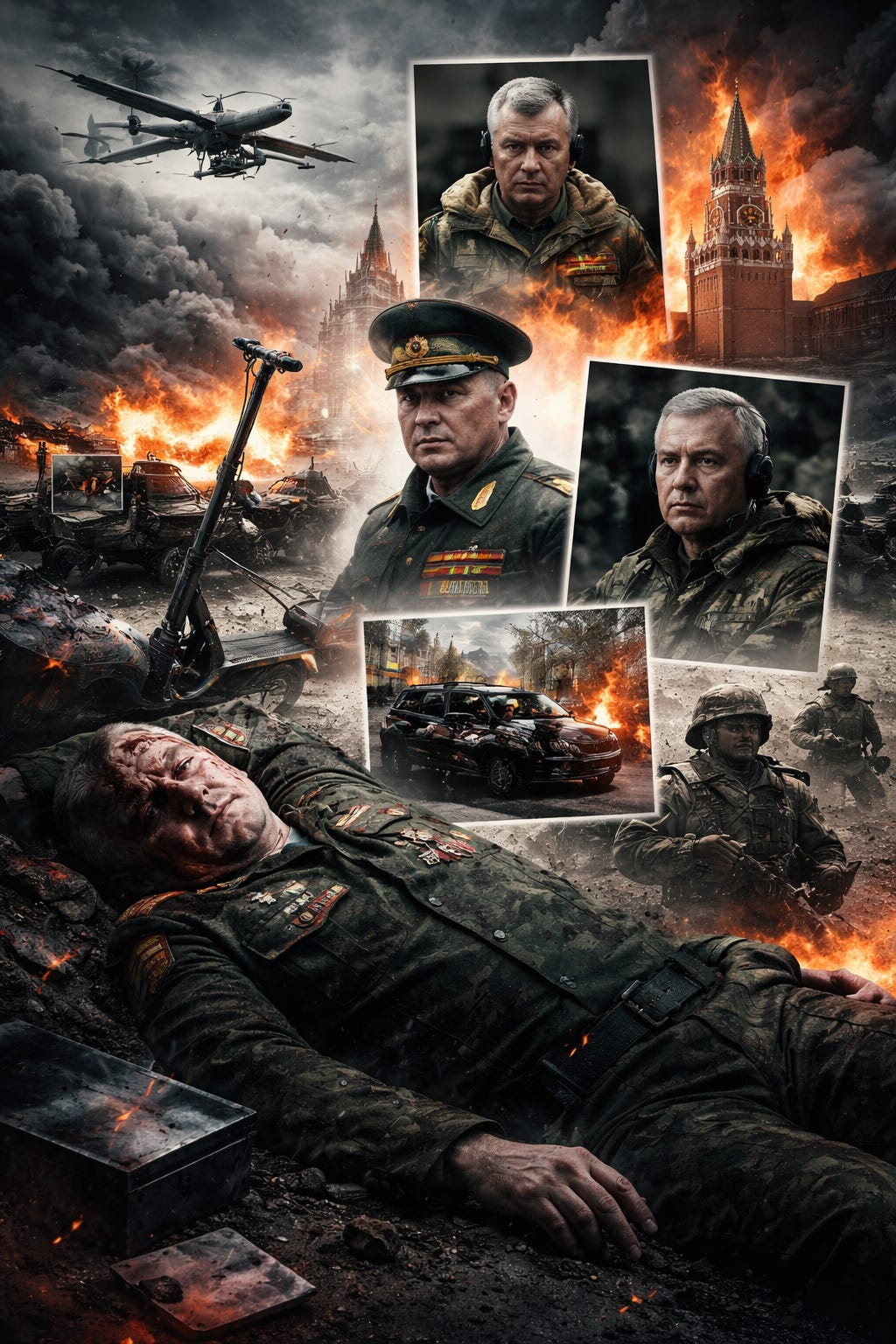
SECTION I: Senior Officers Killed Inside Russia
The extension of Ukraine’s targeting campaign into Russian territory—particularly Moscow—represents a strategic inflection point. These strikes target individuals with documented command responsibility for specific military operations or weapons programs.
Lt. Gen. Igor Kirillov was killed on December 17, 2024, outside his apartment building on Ryazansky Prospekt in Moscow. The method was a remotely detonated explosive device concealed in an electric scooter. His assistant died in the same blast. Kirillov commanded Russia’s Nuclear, Biological and Chemical Protection Troops (RKhBZ). The United Kingdom had sanctioned him in October 2024 for chemical weapons use. Ukrainian prosecutors had charged him in absentia with ordering the deployment of K-1 grenades and CS gas more than 4,800 times against Ukrainian positions. Ukraine’s SBU claimed responsibility. Russia’s Ministry of Defense confirmed his death within hours. (Sources: BBC, Reuters, Russian MoD official statement)
Lt. Gen. Yaroslav Moskalik was killed on April 25, 2025, in Balashikha in the Moscow region. Moskalik served as deputy head of the Main Operations Directorate of the General Staff. The method was a car bomb—an improvised explosive device filled with shrapnel that detonated his vehicle. Russia’s Investigative Committee confirmed the explosion and his death. The Federal Security Service (FSB) announced the arrest of a Russian national, Ignat Kuzin, accused of planting the explosive. Kuzin was sentenced to life imprisonment and reportedly admitted to being recruited by Ukraine’s SBU with the promise of $18,000. Ukraine did not officially confirm involvement, though President Zelenskyy referenced “liquidation” of top Russian military figures following a meeting with Ukraine’s foreign intelligence chief shortly after Moskalik’s death. (Sources: Reuters, Russian Investigative Committee, multiple international outlets)
Lt. Gen. Fanil Sarvarov was killed on December 22, 2025, in southern Moscow. Sarvarov headed the Operational Training Directorate of the Russian Armed Forces General Staff and was a former commander of Russian forces in Syria. The method was a bomb planted under his Kia Sorento that detonated as he drove out of a residential parking area around 7 a.m. The blast destroyed the vehicle from underneath, leaving heavily damaged and bloodied wreckage. Kremlin spokesman Dmitry Peskov said President Putin was “immediately” informed of Sarvarov’s death. Russian investigators opened a criminal case and stated they were considering whether the killing was orchestrated by Ukrainian intelligence services. Sarvarov’s name appeared on Ukraine’s Myrotvorets database, which lists individuals described as “Russian war criminals.” The entry, created in 2022, was updated to note he had been “liquidated.” Ukraine has not officially claimed responsibility. (Sources: Reuters, CNN, Russian Investigative Committee, multiple international outlets)
Maj. Gen. Konstantin Smeshko died on December 26, 2024, on Russian territory. The circumstances of his death have not been officially disclosed by Russian authorities. Multiple reports suggest either an air strike or a HIMARS MLRS strike. Details remain limited pending additional corroboration. (Sources: Militarnyi, The Insider)
SECTION II: Generals Killed in Occupied Ukraine and Combat Zones
Most Russian general officer casualties have occurred in occupied Ukrainian territory or active combat zones in eastern and southern Ukraine. Many deaths occurred in the early months of the invasion when Russian command-and-control structures placed senior officers dangerously close to front-line positions.
Maj. Gen. Andrei Sukhovetsky, Deputy Commander of the 41st Combined Arms Army, was killed near Hostomel in Kyiv Oblast on February 28, 2022, though some sources report March 3. He was a member of the Russian Airborne Forces (VDV). The reported method was sniper fire. His death was confirmed by the Russian Airborne Forces via VK social media and by the Russian paratroopers’ union. He was the first confirmed Russian general killed in the invasion. (Sources: Reuters, BBC Russian Service, Russian military social media confirmations, CNN)
Maj. Gen. Vitaly Gerasimov, Chief of Staff of the 41st Combined Arms Army, was killed on March 7, 2022, near Kharkiv city in Kharkiv Oblast. The method was artillery or rocket strike. Gerasimov was a veteran of the Second Chechen War and the Syria campaign. His death was confirmed through multiple Ukrainian and Western intelligence sources, with intercepted Russian communications reportedly referencing the loss. (Sources: Reuters, The Guardian, Wall Street Journal, Ukrainian Ministry of Defense)
Maj. Gen. Andrei Kolesnikov, Commander of the 29th Combined Arms Army, was killed on March 11, 2022, in eastern Ukraine by artillery strike. His death was reported by Ukrainian sources and confirmed by Russian military bloggers. Some reports in 2023 suggested Kolesnikov may have survived and later appeared in Russian media in Syria, making his status disputed. (Sources: Russian military Telegram channels, Ukrainian General Staff reports)
Maj. Gen. Oleg Mityaev, Commander of the 150th Motorized Rifle Division, was killed on March 15, 2022, in the Mariupol vicinity by artillery strike while leading operations around the besieged city. His death was initially confirmed by Russian state media, including Komsomolskaya Pravda, in a now-deleted article listing general officer casualties. (Sources: Komsomolskaya Pravda deleted article, Reuters, Ukrainian General Staff)
Maj. Gen. Vladimir Frolov, Deputy Commander of the 8th Combined Arms Army, was killed in mid-March 2022 in the Kharkiv region by artillery or precision strike. The death was reported by Ukrainian intelligence and confirmed by Russian military sources. (Sources: Ukrainian military intelligence, Russian military social media)
Lt. Gen. Yakov Rezantsev, Commander of the 49th Combined Arms Army and former Commander of Russian forces in Syria, was killed on March 25, 2022, at Chornobaivka in Kherson Oblast. The method was a precision strike on a command post. Rezantsev had reportedly told troops they would complete the “special operation” in hours. The Chornobaivka airfield and surrounding area became notorious for repeated Russian casualties. His death was confirmed by Russian sources including Novaya Gazeta. (Sources: Novaya Gazeta, Reuters, BBC)
Maj. Gen. Kanamat Botashev, a retired major general recalled to service as a pilot, was killed on May 22, 2022, when his Su-25 ground attack aircraft was shot down by Ukrainian air defenses over Luhansk Oblast. Botashev had retired from the Russian Army but was serving as a mercenary pilot for Russia’s Wagner Group. Aircraft wreckage was documented. This represented a rare instance of a general officer killed in air combat. His death was confirmed by Russian military bloggers and later by official Russian sources. (Sources: Reuters, BBC, Russian Telegram military channels)
Lt. Gen. Roman Kutuzov, Commander of the 1st Army Corps (DPR forces), was killed on June 5, 2022, near Popasna in Luhansk Oblast by artillery strike during the battle for Severodonetsk. His death was confirmed by pro-Russian Donetsk People’s Republic officials and Russian military bloggers. Some sources list him as a major general rather than lieutenant general. Russia officially confirmed his death. (Sources: Russian military Telegram channels, Reuters)
Maj. Gen. Dmitry Ulyanov, a retired major general, was killed on February 6, 2023. Ulyanov commanded a regiment formed from mobilized personnel in Tatarstan. Details of his death remain limited. (Sources: Militarnyi, The Insider, Russian regional reports)
Maj. Gen. Sergei Goryachev, Chief of Staff of the 35th Combined Arms Army, was killed on June 12, 2023, in a missile strike on the army headquarters in Primorsk, Zaporizhzhia Oblast, during the Ukrainian counteroffensive. Goryachev was 52 years old and highly decorated, having fought in the Second Chechen War, overseen a Russian military base in Tajikistan, and led Russian forces in Moldova’s breakaway pro-Moscow region of Transdniestria. Some reports indicate the strike involved British Storm Shadow cruise missiles. Russia confirmed his death. (Sources: Reuters, BBC, Jamestown Foundation, multiple international outlets)
Lt. Gen. Oleg Tsokov, Deputy Commander of the Southern Military District, was killed on July 11, 2023, in Zaporizhzhia Oblast during a Ukrainian missile strike on the reserve command post of the 58th Army in the port city of Berdyansk. Tsokov was 51 years old and had served in both Chechen wars. He had been previously wounded in September 2022 but survived. Reports indicate the strike targeted the command post at the Duna Hotel on Berdiansk Spit. Tsokov had been charged with fraud and abuse of power for pocketing money from contract signing bonuses of soldiers under his command. Multiple sources confirm British Storm Shadow cruise missiles were used in the strike. Russia confirmed his death. (Sources: Reuters, BBC, RBC, Euromaidan Press, multiple international outlets)
Maj. Gen. Vladimir Zavadsky, Deputy Commander of the 14th Army Corps, was killed on November 28, 2023, near the village of Krynky in Kherson Oblast. Russian and Ukrainian media reports offer conflicting narratives of how Zavadsky died. Some reports indicate he stepped on a mine, others suggest he was killed by shelling. Alexander Gusev, governor of Russia’s Voronezh region, confirmed Zavadsky died “at a combat post in the special operation zone.” Russia confirmed his death. (Sources: Al Jazeera, Reuters, Russian regional government statements)
Maj. Gen. Igor Trifonov, a major general of the police who had been stripped of his rank, was killed in action on December 12, 2023. Trifonov was the former head of the Yekaterinburg police department and had been previously convicted of bribery. Russian sources confirmed his death. (Sources: Militarnyi, The Insider)
Maj. Gen. Andrei Golovatsky, a retired major general, was killed on June 30, 2024. Golovatsky previously served as First Deputy Chief of Staff of the North Caucasus Regional Command of the Interior Troops of the Ministry of Internal Affairs. Details of his death remain limited. (Sources: Militarnyi, The Insider)
Maj. Gen. Ildar Saidov, a major general of the Customs Service, was killed on September 14, 2024. After mobilization, Saidov was assigned to the “Storm Z” assault unit. Details of his death remain limited. (Sources: Militarnyi, The Insider)
Maj. Gen. Pavel Klimenko, Commander of the 5th Guards Motor Rifle Brigade, was killed on November 6, 2024, near Krasnohorivka in Donetsk Oblast. The senior Russian officer was killed by a Ukrainian suicide drone near a checkpoint. Klimenko had been accused of organizing torture and collecting money from subordinates for sending them to the rear. The BBC’s Russian service reported, citing relatives of victims, that Klimenko had overseen a “torture camp” of Russian soldiers in Donetsk where servicemen were abused and had their salaries stolen. Russia confirmed his death, and the Kremlin awarded him the “Hero of the Russian Federation” award posthumously. (Sources: Reuters, BBC Russian, The National Interest, multiple international outlets)
Maj. Gen. Mikhail Gudkov, Deputy Commander-in-Chief of the Russian Navy, was killed on July 2, 2025, during a missile strike in Kursk Oblast, Russia. Gudkov had previously commanded the 155th Separate Marine Brigade of the Pacific Fleet, a unit accused of war crimes including torture and execution of prisoners of war in Bucha, Irpin, and Hostomel. Russian authorities stated he was killed “while carrying out a combat mission” in the Kursk region during Ukraine’s incursion into Russian territory. Russia’s Ministry of Defense confirmed his death. (Sources: Reuters, U.S. News, Russian Ministry of Defense)
SECTION III: Colonels and Senior Officers
The number of colonels and regimental-level commanders killed in Ukraine is substantial. By the end of April 2022 alone, at least 317 Russian officers had been killed, a third of them majors, lieutenant colonels, and colonels. By May 2022, reports indicated 42 colonels had been killed. As of mid-2025, BBC Russian and Mediazona documented 144 colonels and 380 lieutenant colonels killed. What follows is a partial list of confirmed cases where Russian sources acknowledged the death, or where multiple international outlets corroborated Ukrainian claims.
Col. Sergei Sukharev, Commander of the 331st Guards Airborne Regiment, was killed in early March 2022 during Kyiv area operations. Ukrainian soldiers spotted his unit driving on an open road near Hostomel and shot at the first and last vehicles, trapping the entire convoy. His death was confirmed by Russian paratroop sources. (Sources: Russian VDV memorial posts, BBC Russian)
Col. Yuri Agarkov, who took command of the 331st Guards Airborne Regiment after Sukharev’s death, was killed shortly thereafter in March 2022 in Kyiv Oblast during combat action. His death was confirmed by Russian sources. (Sources: Russian military Telegram channels)
Col. Konstantin Zizevsky, Commander of the 247th Guards Air Assault Regiment, was killed in March 2022 in Kharkiv Oblast during combat action. Mikhail Vedernikov, governor of the Pskov region, confirmed Zizevsky’s death. His death was confirmed by Russian VDV sources. (Sources: Russian Airborne Forces social media confirmations, Newsweek)
Col. Andrei Zakharov, Commander of the 6th Tank Regiment of the 90th Tank Division, was killed in March 2022 in Kyiv Oblast near Kyiv during combat action in the Kyiv offensive. His death was confirmed by Russian sources and Ukraine’s Defense Ministry. (Sources: Russian military memorial posts, Ukrainian Ministry of Defense)
Col. Sergei Porokhnya, Commander of the 12th Guards Engineer Brigade, was killed in March 2022 in the Kharkiv area while deploying a bridge. His death was confirmed by Russian engineering units and reported via Ukraine’s armed forces Facebook page. (Sources: Russian military Telegram announcements, Ukrainian Armed Forces, Newsweek)
Col. Alexei Sharov, Commander of the 810th Naval Infantry Brigade (810th Guards Separate Order of Zhukov Brigade in the Russian Marines), was killed in March 2022 during combat action in Mariupol during the siege. He was reportedly shot dead in the southern port city. His death was confirmed by Russian naval infantry sources. (Sources: Russian military social media, BBC Russian, Newsweek)
Capt. 1st Rank Andrei Paliy, Deputy Commander of the Black Sea Fleet, was killed in March 2022. Paliy held the naval rank equivalent to a senior colonel. His death represents one of the highest-ranking casualties in the Russian Navy. Multiple sources confirmed his death. (Sources: Multiple international outlets, Ukrainian and Russian reports)
Additional colonels killed in 2022-2024 include unit commanders from multiple branches. A Ukrainian official told The Wall Street Journal that a unit of Ukrainian military intelligence was collecting information on the positions of Russian officers, including generals, artillery commanders, and pilots. By mid-2025, independent tallies confirmed 144 colonels and 380 lieutenant colonels killed, representing a catastrophic loss of mid-level command capability for the Russian military.
Command Responsibility and Lawful Targeting
The targeting of senior military officers in armed conflict is lawful under international humanitarian law. Generals and colonels are combatants. Their command responsibilities—particularly when those commands involve documented war crimes—make them lawful military objectives whether they are in a trench, a command post, or a Moscow apartment building.
Igor Kirillov had command responsibility for systematic chemical weapons deployment. Ukrainian prosecutors had evidence. The UK government had sanctioned him. His death in Moscow was targeted killing of a military commander.
Sergei Goryachev commanded the 35th Combined Arms Army staff. He was killed by a missile strike on his headquarters. Oleg Tsokov was deputy commander of the Southern Military District. He was killed by a Storm Shadow strike on his command post in Berdyansk. Pavel Klimenko commanded a brigade and allegedly ran a torture camp. He was killed by a Ukrainian drone. Mikhail Gudkov commanded a marine brigade accused of war crimes in Bucha. He was killed by a missile strike in Kursk.
Yakov Rezantsev reportedly told his troops the war would be over in hours. He was killed at Chornobaivka. Roman Kutuzov commanded DPR forces in Luhansk. He was killed by artillery. Andrei Sukhovetsky was deputy commander of an army assaulting Hostomel. He was killed by a sniper.
The pattern extends to Moscow itself. Kirillov killed by a scooter bomb outside his apartment. Moskalik killed by a car bomb in Balashikha. Sarvarov killed by a bomb under his vehicle in southern Moscow. These are not terrorism. These are targeted killings of military commanders with command responsibility.
Ukraine’s accountability campaign operates under a principle: if international courts cannot or will not deliver accountability, the battlefield will.
The record speaks for itself.
Chris Sampson is Editor-in-Chief of NatSecMedia and an independent journalist based in Kyiv, Ukraine. He has covered Russia’s invasion since February 2022 and provides analysis for international media including BBC.
SOURCES AND METHODOLOGY
This article relies on Russian Ministry of Defense official statements, Russian military social media channels and memorial posts, Reuters, Associated Press, BBC, CNN, Al Jazeera, Wall Street Journal, The Guardian, The Moscow Times, Novaya Gazeta, Ukrainian Ministry of Defense and Security Service statements, UK government sanction announcements, intercepted communications referenced in Western intelligence assessments, Russian regional government announcements, independent investigative outlets including Mediazona and The Insider, and open-source casualty tracking by BBC Russian service.
Cases without Russian confirmation or multiple international outlet corroboration were excluded. All dates and details were cross-referenced across multiple outlets where possible. The total count of 19 generals comes from independent investigations by The Insider, Militarnyi, and other outlets tracking open-source data. Russia has officially confirmed 13 general officer deaths as of December 2025. The colonel and lieutenant colonel casualty figures (144 colonels, 380 lieutenant colonels) come from BBC Russian service and Mediazona’s ongoing verification project, which uses obituaries, social media posts, and official statements to confirm deaths.