
The Algorithmic Bargain
Ukraine is building the world’s most advanced AI war machine. The question that needs asking is who owns it.

DEAR READER: If independent journalism matters to you, please consider a $5/month membership. I report daily from inside Ukraine’s war — through blackouts, through attacks — and your support makes that possible. These dispatches will remain free to all readers. This work depends on those willing to sustain it, and I’m grateful to everyone who does. — Chris Sampson, Kyiv, May 21, 2026, Day 1547 of full scale Russian war against Ukraine.
In September 2025, I stood on the pitch of a football stadium in Lviv watching investors and defense ministers circle a supersized mock-up of the Toloka TLK-150 unmanned underwater vehicle. More than 5,000 people from 50 countries had come to Brave1’s Defense Tech Valley summit — the largest defense innovation event in Ukraine’s history. Four companies from Europe and the United States pledged over $100 million in a single afternoon. Minister Fedorov took the stage and said the quiet part out loud: “If you are not in Ukraine, you are not in the defense technology market.”
Two months later, I was in Kyiv at the WINWIN Summit, watching a Mistral AI executive warn — in a room full of American and European technology executives who had just signed cooperation agreements with Ukraine — that any country without its own AI competence risks becoming “an AI colony.” The irony was apparent. The speaker list included Google, OpenAI, Microsoft, Cisco, and ElevenLabs. Every one of them was there to help Ukraine build the AI nation. Every one of them was also, structurally, a dependency.
That tension — between the genuine necessity of these partnerships and the sovereignty costs they carry — is the most important unasked question in the coverage of Ukraine’s technological transformation. I have been reporting on this ecosystem from Kyiv since before the full-scale invasion began. I covered Ukraine going from 102nd to 5th in the world for digital government services. I watched the country build 500 drone companies out of nothing. I reported on Diia.AI becoming the world’s first national AI assistant for government services while Russian drones were still in the air outside. The ambition is real. The achievement is real. And the risk is real — and it is structural, not conspiratorial.
This is the piece I have been building toward.
PART I. What Ukraine Has Actually Built
Start with the numbers, because they are staggering and they matter.
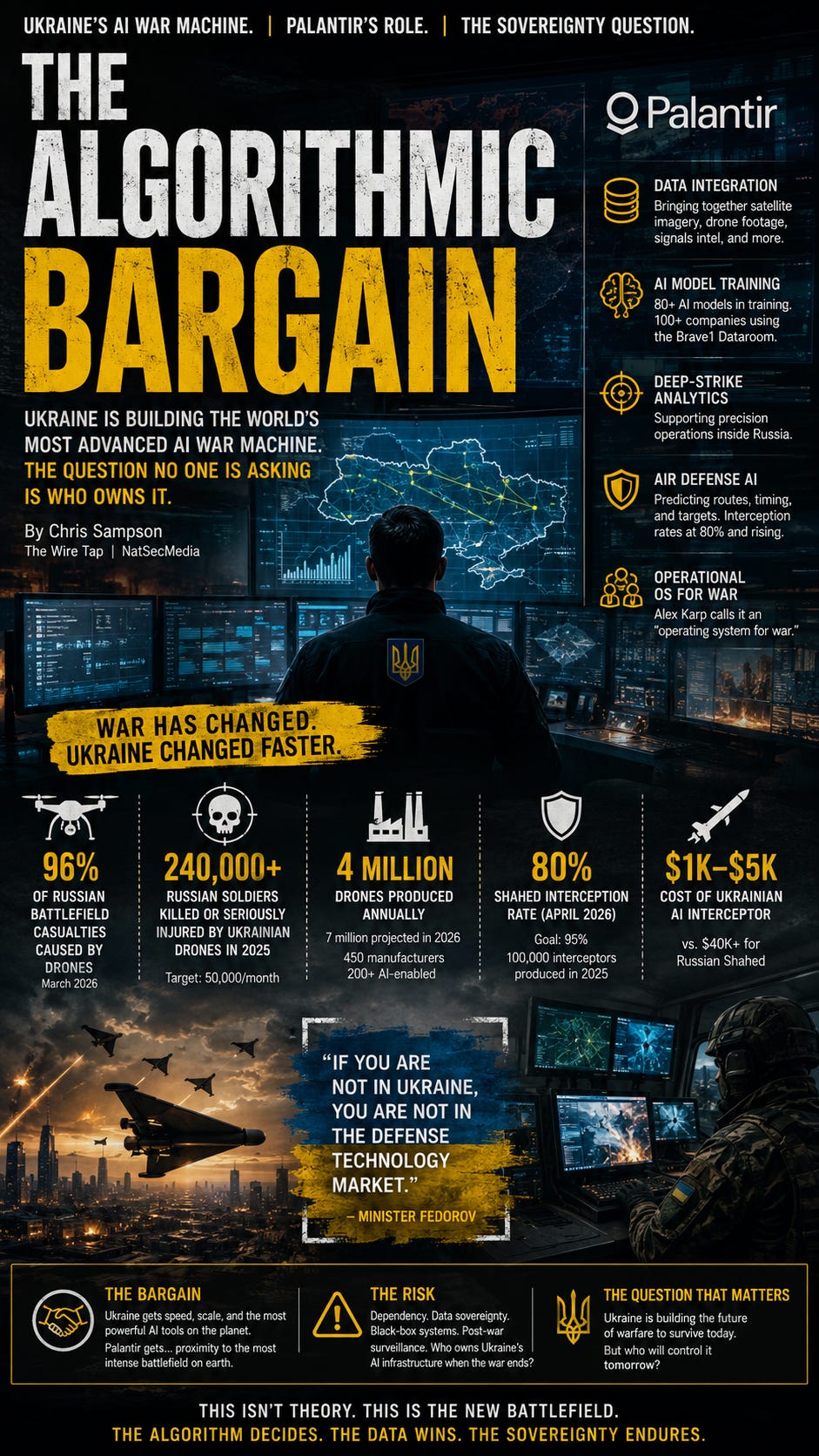
In March 2026, drones accounted for 96 percent of Russia’s 35,551 battlefield casualties. Ukrainian drones killed or seriously injured more than 240,000 Russian soldiers in 2025 alone — a figure that represents a strategic inflection point in how wars are fought and won. President Zelenskyy’s stated target is 50,000 Russian casualties per month through drone attrition, a number his military believes, if reached, will offset Russia’s personnel advantage permanently.
Ukraine is producing roughly four million drones annually across aerial, ground, and maritime categories, moving toward a projected seven million in 2026. The country hosts approximately 450 drone manufacturers, with 40 to 50 considered top-tier. Over 200 companies are producing AI-enabled drones. More than 300 developments are registered on the Brave1 platform. More than 70 AI and computer vision systems are actively deployed on the front.
The interceptor economics alone represent a doctrinal revolution. Russian Shahed drones cost upwards of $40,000. Ukrainian AI-guided interceptors cost between $1,000 and $5,000. The Sting interceptor — produced at over 10,000 units per month as of March 2026 — was responsible for 70 percent of intercepted jet-powered Shahed drones in April 2026 and had accumulated over 3,900 confirmed kills by February. Ukraine’s National Security Council reports approximately 100,000 interceptor drones were produced in 2025 alone. Commander-in-chief Syrskyi put the current Shahed interception rate at roughly 80 percent. The stated goal is 95.
This is not a pilot program. This is industrial-scale autonomous air defense, and Ukraine built it under active bombardment, by compressing the development cycle from years to weeks through battlefield feedback loops that no peacetime military can replicate.
And underlying all of it — the data architecture, the AI training environment, the intelligence fusion, the deep-strike analytics — is Palantir.
PART II. What Palantir Actually Does Here
Palantir Technologies entered Ukraine in 2022 following an early meeting between CEO Alex Karp and President Zelenskyy — described by Time magazine as involving armored car convoys, emergency medical kits, and border crossings that were anything but routine. The company initially provided services free of charge. It has since become structurally embedded in Ukraine’s AI-warfare architecture at a level that is operationally significant, partially opaque, and under-examined by virtually every major outlet covering the war.
The most visible manifestation is the Brave1 Dataroom, launched January 20, 2026. The platform is a secure digital environment in which Ukrainian defense companies can train and validate AI algorithms against real-world military intelligence on Russian aerial threats — without direct access to the underlying sensitive databases. More than 100 companies are currently using this environment. More than 80 AI models are in training. The system runs on Palantir infrastructure.
But the Dataroom is the public face. What Palantir likely provides at depth includes: data integration across heterogeneous intelligence sources — satellite imagery, drone footage, battle reports, signals intelligence, open-source information — fused into a unified analytical platform; battlefield dataset management, including the organization and annotation of millions of labeled combat frames for neural network training; analytics workflows that allow intelligence analysts to query and extract insights from volumes of data no human team could process manually; air-defense predictive modeling for Russian attack routes, timing, and target selection; and — by multiple credible accounts — analytics support for deep-strike planning against targets inside Russia.
Alex Karp has publicly described Ukraine’s use of his company’s technology as an “operating system for war” — one that tracks, in his framing, battlefield performance down to the level of individual military units: what worked, what didn’t, what means were used, what effects were achieved. That is not a peripheral capability. That is the command-and-control layer of a modern fighting force.
PART III. The Data Sovereignty Problem
Here is the question that should be on the front page of every publication covering this war: who owns Ukraine’s battlefield data?
Ukraine possesses what is, without serious contest, the most valuable real-combat AI training dataset in the world. Millions of annotated frames from tens of thousands of combat drone missions. Real-time intelligence on Russian aerial threats. Kill-chain analytics. Operational patterns from three years of industrial-scale drone warfare. This data is what makes Ukrainian AI models trainable, accurate, and battle-tested in ways that no simulation can replicate. At European and American defense conferences, the phrase “Tested in Ukraine” has become a market-defining certification precisely because of this dataset.
That dataset is now flowing, in substantial form, into Palantir’s infrastructure.
The terms governing what Palantir can hold, access, share, or retain after contract termination are not public. They have never been made public. Ukrainian parliamentary oversight of this arrangement — if it exists — has not been publicly documented. The data governance framework governing Ukraine’s relationship with its most strategically valuable asset is, to the extent of available public information, a black box.
This is not an abstraction. Switzerland — a neutral, technologically sophisticated, thoroughly non-adversarial democracy — discontinued Palantir services in December 2025 after an internal audit raised concerns that data could be leaked to U.S. government and intelligence agencies. Switzerland’s data was administrative and financial. Ukraine’s data is military, operational, and directly tied to its survival. The structural concern that caused Switzerland to act is present in Ukraine’s deployment in amplified form, under wartime emergency conditions, without equivalent auditing or transparency.
Every Ukrainian soldier whose drone footage was annotated and fed into a training model has contributed to an asset whose ownership and governance remain undisclosed. That is a sovereignty problem. It is also a democratic accountability problem. And it is happening right now, at scale, without public debate.
PART IV. The Dependency Trap
Enterprise software has a structural logic that operates independently of anyone’s intentions: switching costs accumulate. The deeper a platform integrates into institutional workflows, the more expensive it becomes to exit — not because anyone designed a trap, but because integration is the product.
Ukraine’s military architecture is becoming structurally dependent on Palantir at the layer that matters most: the AI training environment for air-defense systems, the intelligence fusion layer for operational planning, and the data infrastructure for the most sensitive battlefield analytics. Each new model trained in the Brave1 Dataroom deepens this integration. Each new analytical workflow built on Palantir’s platform increases the cost of switching. Each military unit that builds its operational picture around Palantir-supported outputs adds another dependency node.
If Palantir withdrew from Ukraine — through commercial decision, U.S. government pressure, policy change, or financial distress — which Ukrainian systems would degrade, and how fast? Has Ukraine built parallel domestic capabilities, or is it structurally dependent on continued Palantir access? These questions do not have public answers. They may not have answers that Ukrainian officials themselves know with confidence.
The 2025 Trump administration pause on U.S. military assistance demonstrated the category of risk concretely. When Washington changed political configuration, Ukrainian systems dependent on American platforms were immediately affected. Palantir is a private company, not a government program — but the U.S. government has historically been able to influence, restrict, or redirect private defense contractors operating in sensitive allied contexts. The precedents exist. The structural vulnerability is real regardless of current intentions or current political configuration in Washington.
This is not an argument against the partnership. It is an argument for building the governance architecture that makes the partnership durable, transparent, and sovereign — before the dependency becomes irreversible.
PART V. The Black Box Targeting Problem
When a Ukrainian AI-guided interceptor drone acquires a target and autonomously pursues and destroys it — bypassing Russian electronic warfare jamming in the terminal phase — who made the targeting decision? The operator who launched the drone? The algorithm that achieved lock-on? The Palantir analytics that helped train the detection model? The Ukrainian military procurement officer who selected the system?
This question is not theoretical. It is operational, and it is happening thousands of times per week across the Ukrainian front.
International humanitarian law requires meaningful human control over lethal targeting decisions. Ukraine has formally committed to maintaining human-in-the-loop oversight. But the operational reality of AI-guided terminal guidance — where the drone completes its approach and engagement autonomously once radio contact is severed by jamming — is a human-on-the-loop system at best. The human authorized the mission, not the individual engagement. At the speeds and volumes involved, the distinction is not merely semantic.
If Palantir’s analytics infrastructure contributes to target prioritization — including for deep strikes inside Russia, which multiple credible reports link to Palantir-supported intelligence processing — and those analytics later prove to have informed strikes that caused unlawful civilian harm, the accountability chain is undefined. International humanitarian law has no framework for corporate accountability in AI-assisted lethal operations. Ukraine bears the legal exposure. Palantir, as a private contractor providing analytical tools, does not.
This is not a hypothetical about future autonomous weapons. It is a present-tense legal and ethical gap in one of the most active conflict zones on earth, involving one of the most sophisticated AI-warfare ecosystems ever deployed. The frameworks for addressing it are not being built in public. They may not be being built at all.
The International Committee of the Red Cross issued a stark warning in its March 2025 report: without limits, the rise of autonomous weapons risks crossing a moral and legal threshold that humanity may not be able to reverse. The UN Secretary-General has called for a legally binding treaty on autonomous weapons by 2026. That treaty does not exist. The battlefield is not waiting.
PART VI. The Agentic State and the Dual-Use Problem
In November 2025, at the WINWIN Summit I covered in Kyiv, Minister Fedorov announced that Ukraine would become the world’s first “agentic state” — a government that doesn’t just respond to citizen requests but anticipates them, delivering services before they are asked for. Diia.AI had just become the world’s first national AI assistant for government services, serving 23 million people. Fedorov said 70 percent of the legal work inside his ministry was already being processed by AI, with humans signing off at the end. Ukraine had gone from 102nd to 5th in the world for digital public services in less than a decade.
This is an extraordinary achievement. It is also a dual-use architecture.
The data fusion platforms, predictive analytics engines, and AI classification systems being built for wartime military use share technical foundations with the systems being built for civilian government services. The same infrastructure that identifies Shahed drones can identify civilian vehicles. The same predictive modeling that anticipates Russian attack routes can anticipate human movement patterns. The same annotated datasets that train military target-recognition models can inform civilian population-monitoring systems.
Ukraine’s national AI strategy, as presented at WINWIN, explicitly acknowledges the dual-use character of its development. The three-pillar framework developed with Estonian advisors — integration across all levels, AI sovereignty, and data/talent/infrastructure activation — is designed for the full stack: defense, government services, enterprise, individual. The same AI Factory that will power Diia will power military analytics. The same Kyivstar-developed national language model intended to resist Russian disinformation will be trained on data whose collection and governance frameworks are still being designed.
Wartime AI infrastructure built under emergency conditions has a documented tendency to outlast the emergency that justified it — and to be repurposed for domestic security functions that would not have been politically viable in peacetime. This is not a paranoid projection specific to Ukraine. It is documented pattern. Ukraine has strong civil-society institutions and democratic traditions. It also has years of conflict normalization, emergency-measure precedents, and a defense-industrial complex growing at extraordinary speed with extraordinary international investment. The governance frameworks governing the transition from wartime emergency tools to peacetime democratic infrastructure are not being built in public. They need to be built now, while the systems are being designed — not after the war, when they are entrenched.
PART VII. The AI Colony Warning, from Inside the Room
Audrey Herblin-Stoop, Vice President of Global Public Affairs at Mistral AI, delivered the sharpest line of the WINWIN Summit. “Europe must invest in and champion its own AI,” she said. “If we don’t own it, we risk becoming an AI colony — and losing our geopolitical influence.”
She said this in a room where Ukraine was simultaneously signing cooperation agreements with Google, OpenAI, Microsoft, Cisco, and ElevenLabs. The irony was not lost on the Ukrainians present. Fedorov had framed the strategy as “win-win”: Ukraine gets expertise and capability; the technology companies get a real-world testing environment and a partnership that creates mutual value. Google’s Anna Bulakh put it plainly: “Ukraine isn’t just consuming technology. It’s helping advance it.”
That framing is accurate. It is also incomplete.
When Ukraine feeds Palantir’s infrastructure with the world’s most valuable military AI training dataset, the value flows in both directions. Palantir gains access to real-combat annotated data that makes its AI products more capable, more accurate, and more marketable globally — including to other governments, including to NATO allies currently watching Ukraine’s model with great interest, including to the defense establishment of the United States. At European defense conferences, the “Tested in Ukraine” certification has become a market premium. Ukraine is not only consuming technology. It is also producing it — and the question of who captures that production value is not settled.
Volodymyr Brusilovsky of UNDP said it explicitly: “If AI is as transformative as the Internet was in the 2000s, then any country without its own AI competence will be dependent on others.” Ukraine is building AI competence at speed under fire. But competence built on foreign infrastructure, trained with data governed by foreign corporate terms, and analytically dependent on foreign platforms is a contingent competence. It lasts as long as the partnerships hold.
Ukraine’s national AI strategy does include a sovereignty pillar. The Kyivstar-developed national language model is specifically framed as disinformation-resistant precisely because it will be trained on Ukrainian data under Ukrainian control. The AI Factory concept is designed to provide domestic compute infrastructure. These are the right instincts. The question is whether they are being built fast enough and robustly enough to provide genuine alternatives to deep Palantir dependency before that dependency becomes structural and irreversible.
PART VIII. The Russia Comparison Nobody Wants to Make
Russia is, in formal terms, further behind on AI warfare than Ukraine. Its innovation speed is slower, its quality control is worse, its AI talent has emigrated in significant numbers since 2022, and it is locked out of Western compute and chip supply chains by sanctions. These disadvantages are real.
But Russia is catching up, and it is catching up through a partnership that carries its own sovereignty costs — specifically, an approximately 80 percent dependence on Chinese components for its drone program, with Chinese engineers actively collaborating on autonomous systems development. Russia’s V2U autonomous loitering munition, deployed from February 2025 and scaling to 30-50 units per day by May 2025, runs on an Nvidia Jetson processor — a Western chip obtained despite export controls, through supply chains Ukraine’s military intelligence has documented in recovered components. The Lancet loitering munition family is under active AI integration using the same chip architecture, confirmed by HUR analysis of wreckage recovered in Kyiv in March 2026. Russia’s Presidential Commission on AI Development was established by presidential decree in February 2026.
The strategic picture on both sides is therefore: two nations fighting a war with AI systems that are structurally dependent on foreign technology partners — Ukraine on American corporate infrastructure, Russia on Chinese state-adjacent industrial supply chains. The sovereignty problems are different in character. Russia’s authoritarian governance makes the political accountability question moot; Chinese component dependency is a strategic vulnerability but not a democratic governance failure. Ukraine’s dependency on Palantir and Western platforms is a democratic governance question as well as a strategic one: it involves private foreign corporate access to the national security architecture of a democracy fighting for its survival.
That asymmetry matters. Russia does not have to answer to its citizens about who can access its military AI training data. Ukraine does. Or should.
PART IX. The Compute War Ukraine Is Losing Quietly
There is a vulnerability in Ukraine’s AI-warfare model that receives almost no public attention, and it may be more consequential than any individual weapons system or corporate dependency.
Ukraine operates approximately 58 data centers. Russia operates approximately 251.
As drone production scales toward seven million units per year, as AI models grow more complex, as the Brave1 Dataroom expands to more companies training more models on more data, as DELTA’s neural networks require continuous retraining to keep pace with Russian camouflage and countermeasure adaptation — the compute demands of Ukraine’s AI-warfare ecosystem will outstrip available domestic infrastructure by orders of magnitude.
The current solution is foreign cloud infrastructure: Palantir’s platforms, Microsoft’s cloud (the company has committed over $500 million in support to Ukraine since 2022, including cloud infrastructure and cybersecurity services), and Google’s Gemini model powering Diia.AI. This is operationally necessary and strategically concerning simultaneously. It means that the computational layer of Ukraine’s most sensitive AI operations runs on foreign infrastructure outside Ukrainian physical and legal jurisdiction.
The AI Factory concept — government-funded domestic infrastructure for developing and testing AI — is the right response. Ukraine’s 2030 targets include 200 million GPU hours available annually to Ukrainian researchers, a figure that represents meaningful ambition. But ambition and implementation are different things, and implementation requires physical infrastructure, reliable power, cybersecurity hardening, and technical personnel — all of which are simultaneously under Russian attack. Russia has destroyed or damaged the majority of Ukraine’s civilian power generation capacity. Building sovereign compute infrastructure in that environment is an extraordinary challenge.
Ukraine’s former commander-in-chief Valeriy Zaluzhnyi said Ukraine must win the AI competition no later than 2027. The compute gap is the hardest constraint on meeting that timeline domestically.
PART X. What Winning Actually Requires
The summary judgment on Ukraine’s AI-warfare model is this: it is working, it is impressive, it is genuinely innovative, and it is building dependencies that will outlast the war in ways that Ukrainian democratic institutions are not currently equipped to govern.
Palantir is probably strategically necessary to Ukraine right now. The speed, scale, and sophistication of the Brave1 Dataroom — 100 companies training 80 models on real combat data — is not something Ukraine could have built from scratch on the same timeline. The intelligence fusion capabilities almost certainly improve targeting quality, reduce friendly fire, and enable the kind of battlefield management that DELTA has demonstrated to be dramatically superior to NATO’s Cold War-era alternatives. The air-defense predictive modeling is plausibly saving civilian lives every time it improves a Shahed interception rate by a percentage point.
None of that resolves the following:
The terms of Ukraine’s data-sharing agreement with Palantir are not public. The governance framework governing AI targeting systems is not public. The parliamentary oversight mechanism for AI-assisted kill-chain processes does not exist in documented public form. The plan for transitioning wartime AI infrastructure to post-war civilian governance has not been published. The prohibitions against repurposing military AI systems for domestic surveillance have not been legislated. The audit process for IHL compliance of AI models used in targeting workflows has not been established publicly.
These are not bureaucratic niceties. They are the difference between a democracy that uses AI to survive and a democracy that builds its own surveillance state in the process of surviving. They are the difference between strategic partnership and strategic dependency. They are the difference between Ukraine owning the most valuable military AI dataset in the world and Palantir owning it.
The Ukrainian government’s message to international investors at Defense Tech Valley was simple and correct: if you are not in Ukraine, you are not in the defense technology market. The message Ukraine needs to hear in return is equally simple: if you do not govern your AI infrastructure as a democracy would, you risk winning the war and losing the state.
Fedorov’s philosophy, stated clearly at WINWIN, is that “done is better than perfect — done while others are still planning is how you win.” Under bombardment, that philosophy has produced miracles. Applied to AI governance, it produces the conditions for a different kind of defeat: one that arrives after the guns go quiet, written in data terms and sovereign dependency rather than territorial loss.
Ukraine has owned its problems under fire in ways that have astonished the world. The governance problem is the next one to own. The window for doing it while the architecture is still being built — rather than after it is entrenched — is closing.
The question for every reader who cares about Ukraine’s survival as a democracy, and not merely as a territory: are you tracking this? Because the people building the AI-nation are moving fast. And the people who should be asking these questions are mostly still catching up.
Chris Sampson is Editor-in-Chief of NatSecMedia and host of The Wire Tap on Substack. He has lived and reported in Kyiv since January 2022.
Masterclass. Thoroughly enjoyed.