
The Thread That Remains
On Vyshyvanka Day, Ukraine wears its inheritance. Russia keeps trying to bury it.

DEAR READER: If independent journalism matters to you, please consider a $5/month membership. I report daily from inside Ukraine’s war — through blackouts, through attacks — and your support makes that possible. These dispatches will remain free to all readers. This work depends on those willing to sustain it, and I’m grateful to everyone who does. — Chris Sampson, Kyiv, May 21, 2026, Day 1547 of full scale Russian war against Ukraine.
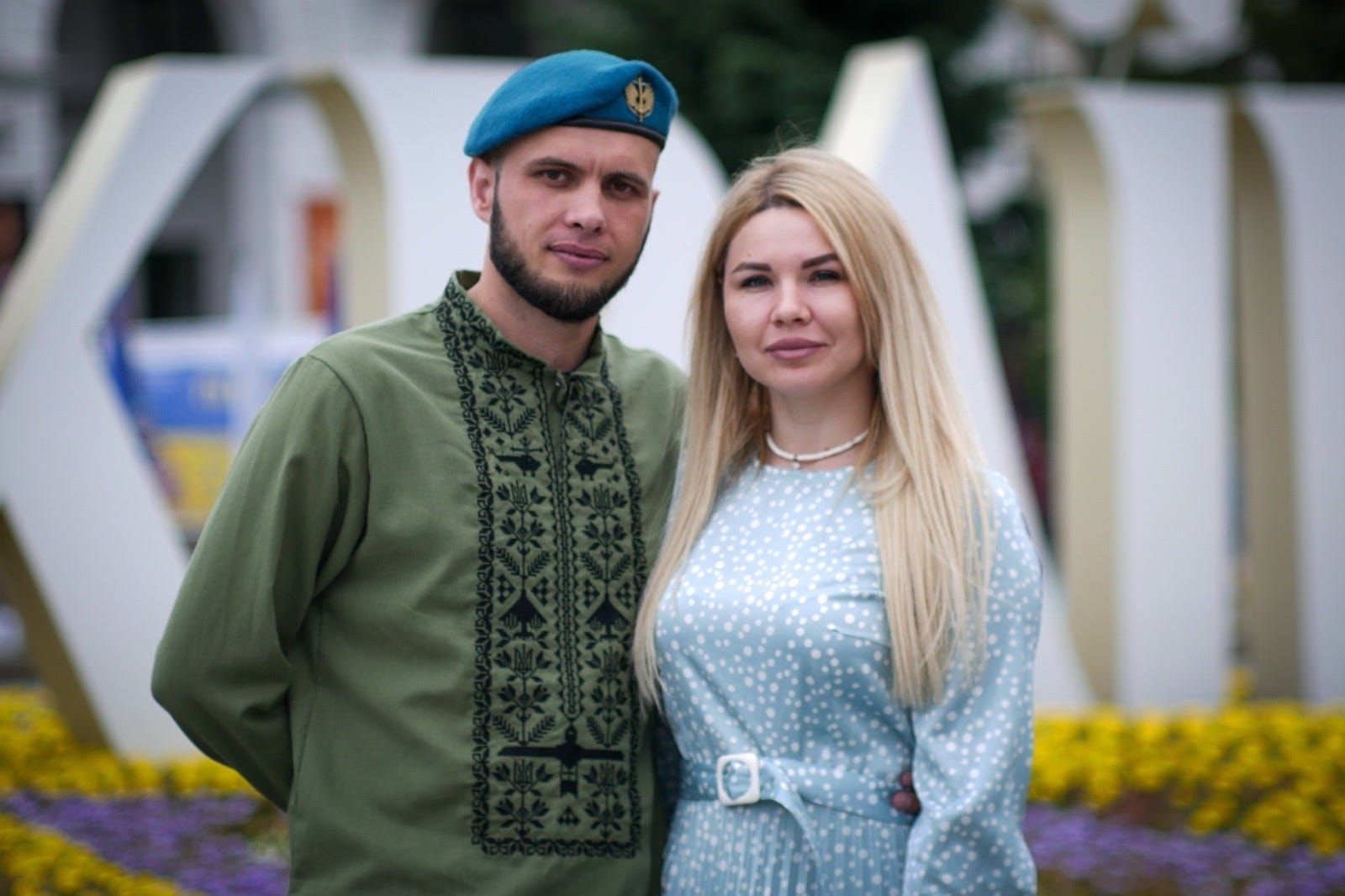
She is wearing a white linen vyshyvanka with black geometric stitching at the collar and sleeves — Poltava region style, if you know how to read it, which I’ve slowly learned to do.
She doesn’t flinch at the alarm tone on every phone around her. She finishes the arrangement, sets it in the bucket, then walks calmly into the metro stairwell along with everyone else.
Underground, the fluorescent light turns every embroidered shirt into a small museum.
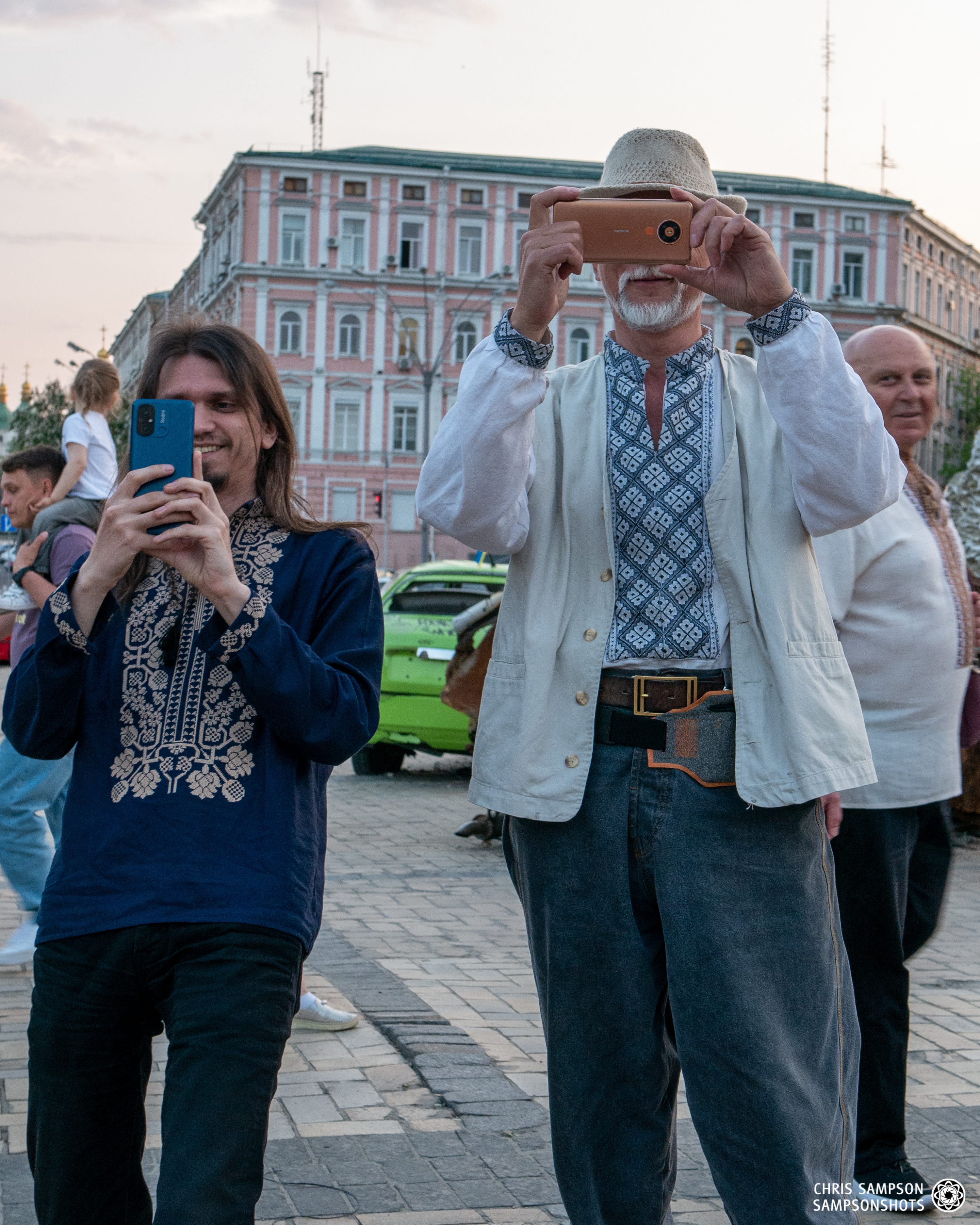
A girl of maybe seven is in full ceremonial dress — deep red cross-stitch on white linen, a flower wreath already slightly tilted over one ear. Her mother straightens it without looking up from her phone. An older man in a jacket with embroidered cuffs visible at the wrists leans against a pillar and stares at nothing in particular. Three young women have co-ordinated — loosely, in the way of friends who texted each other about it — cream blouses with different regional patterns.
They are talking at speed in the particular way Kyiv women talk when they are pretending not to be frightened.
The all-clear comes in twenty-three minutes. Everybody goes back up to the sunlight. The woman at the kiosk is already back behind her flowers.
This is Vyshyvanka Day in wartime. It looks, from the outside, like a cultural holiday.
It is not a cultural holiday. It is a political act dressed as a cultural holiday, which is the only kind of cultural act Ukraine has ever really been permitted to have.
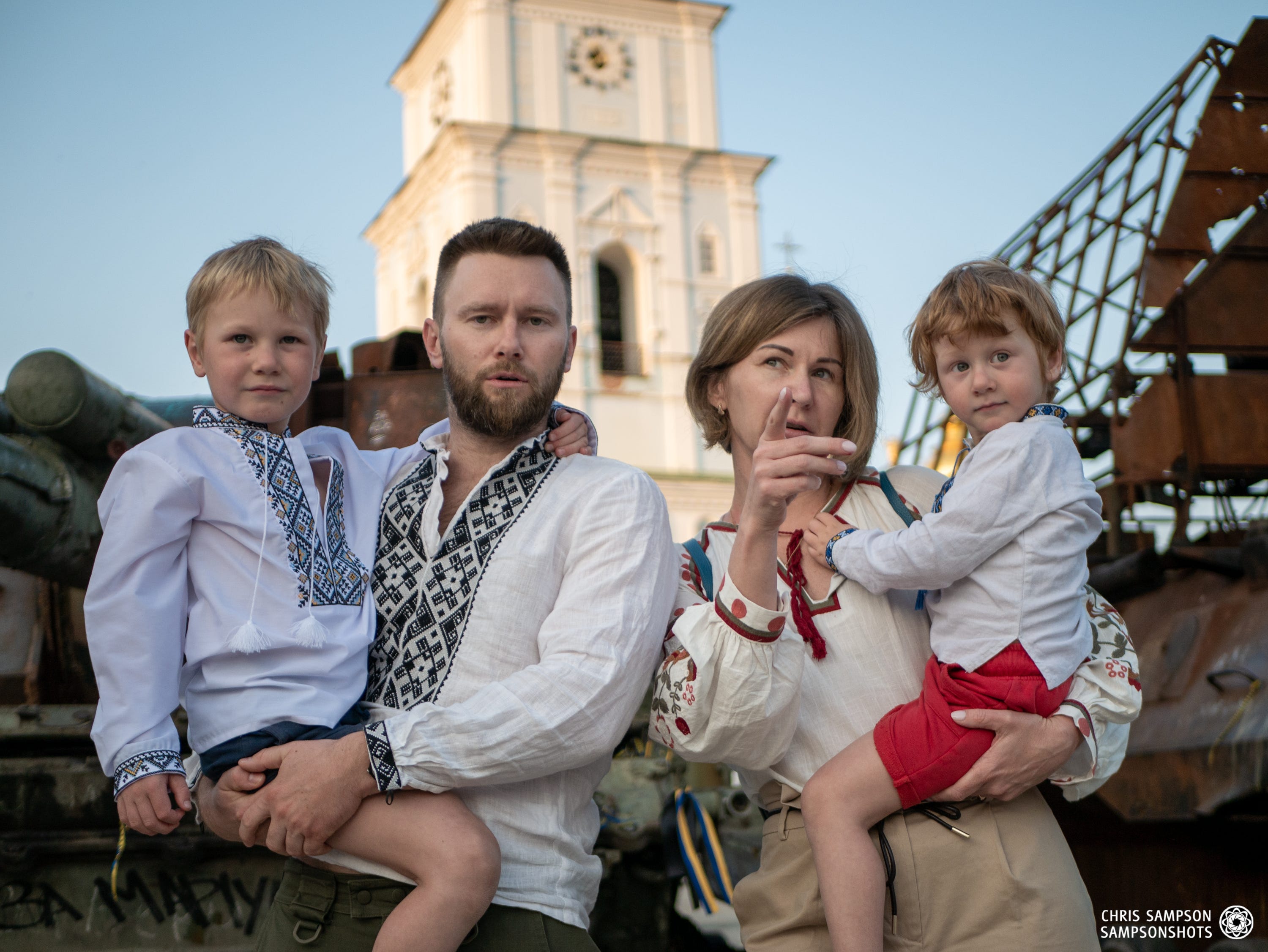
Let me tell you what a vyshyvanka actually is, because the word gets used in translation as “embroidered shirt” and that flattens it to near-meaninglessness, the way translating dusha as “soul” loses about two-thirds of the freight.
The vyshyvanka is a garment made with intent. The embroidery is not decorative in the way a print on a mass-market blouse is decorative. It is encoded.
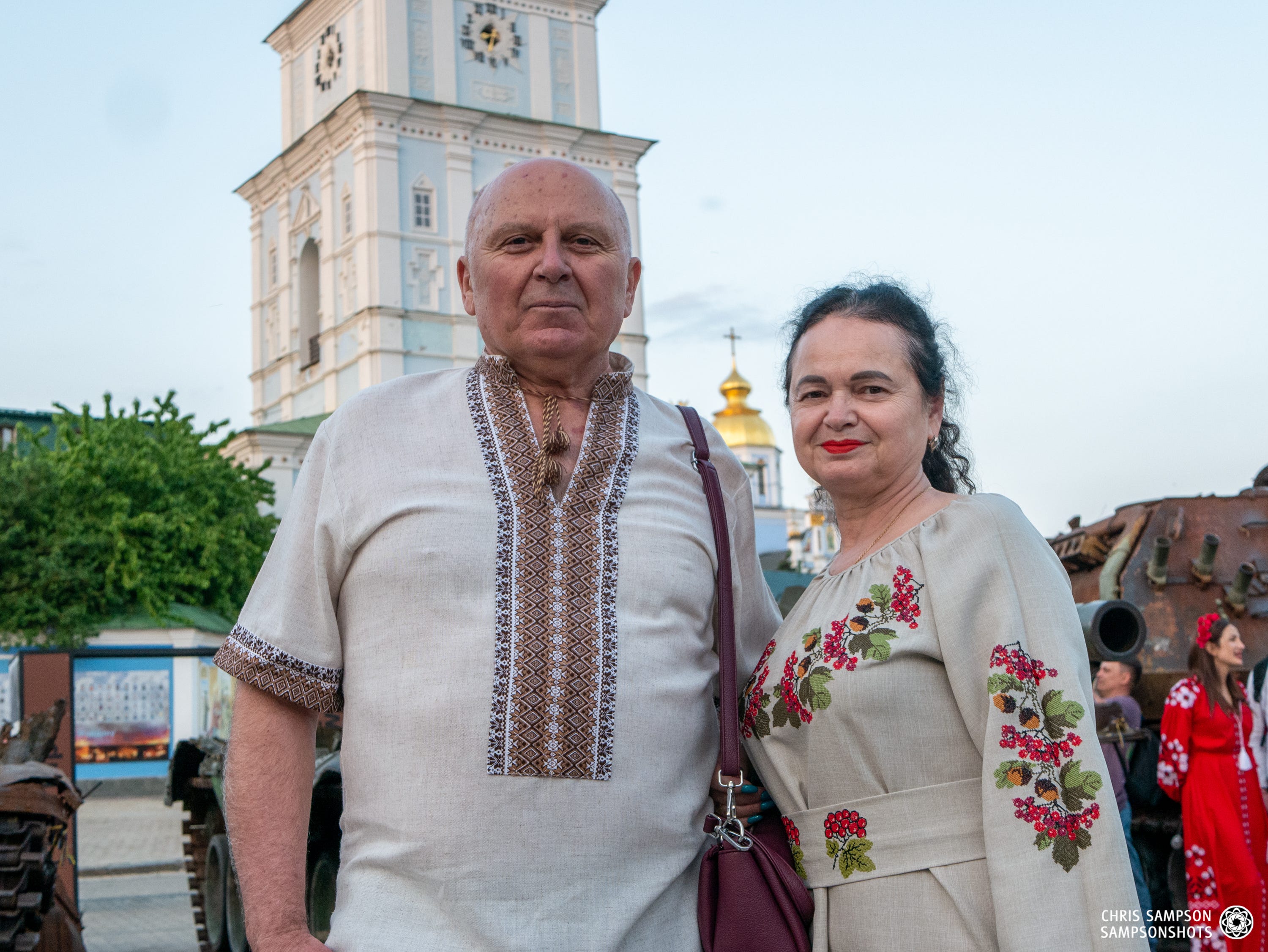
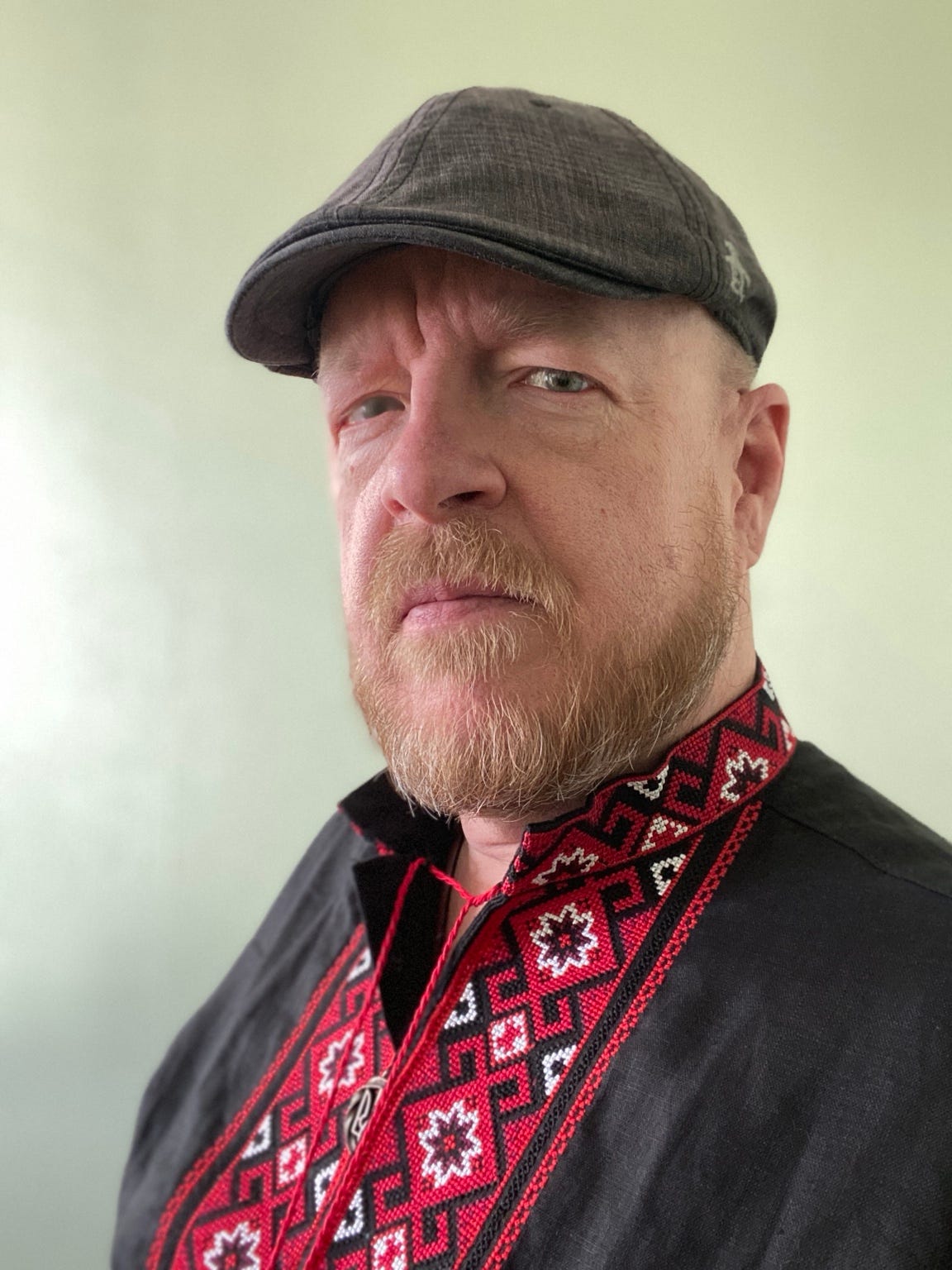
Each region of Ukraine has its own system of motifs, colors, and geometric logic. Poltava is typically black and red on white linen. Kyiv region uses rich red on white with floral spirals. Hutsul embroidery from the Carpathian highland communities is dense and polychromatic, almost hallucinatory. Bukovyna uses fine geometric patterns that could pass for Islamic tile work if you didn’t know better. Podillia favors complex cross-stitch with botanical themes so detailed they function as field guides.
You can read a shirt’s origin like a dialect.
Within those regional systems, families have patterns. Passed down not as heirlooms — though some vyshyvankas are indeed kept in chests for generations — but as knowledge. A grandmother teaching a granddaughter a particular stitch is not teaching her embroidery.
She is passing on a coordinate. This is where we are from. This is what our hands know how to do.
The patterns also carry symbolic meaning, though this gets complicated by the century-long interruption of Soviet rule during which much of that lexicon was suppressed, forgotten, or altered. Sun symbols, ram’s horns, infinity knots, oak leaves, viburnum berries, the tree of life, eight-pointed stars — these motifs predate Christianity in many cases, layer onto Christian symbolism in others, and exist in a palimpsest of meaning that scholars argue about and ordinary Ukrainians carry without necessarily decoding.
What matters is the carrier, not always the decoded signal.
The vyshyvanka says: I am from somewhere specific. My ancestry is specific. I am not a generic Soviet citizen.
That specificity is exactly what the Soviet project worked for seventy years to dissolve.
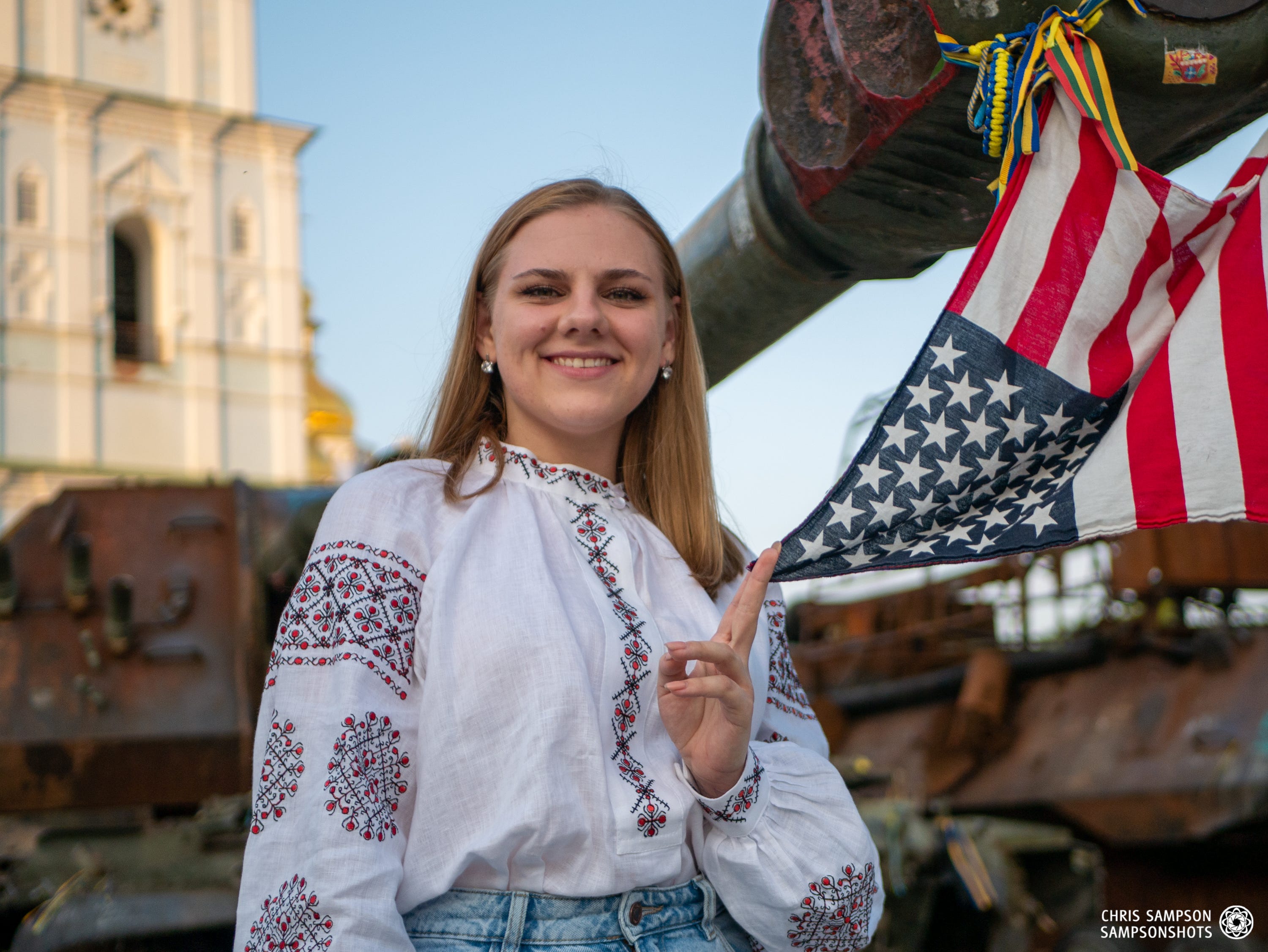
The third Thursday of May became Vyshyvanka Day through a student initiative at Chernivtsi National University in 2006 — Lesya Voronyuk simply proposed that everyone wear their embroidered shirts to class on the same day.
No committee, no ministry, no official sanction.
It spread by the organic logic of an idea that was ready to exist. By 2010 it had reached across Ukraine. By 2015, after the Maidan and the start of the first Russian occupation, it had become something else entirely — a civilian uniform of resistance. By 2022, after February 24th, it had become a signal you could read from fifty meters.
I am still here. We are still here.
The date was eventually recognized by the Ukrainian government, which is how these things work — civic society creates meaning, institutions follow — but the holiday belongs to the people who kept wearing their grandmothers’ shirts even when that was a political risk, which it was, not as ancient history but within living memory.
There are elderly people alive in Ukraine today who remember when speaking Ukrainian in certain contexts was professionally dangerous. Who remember the deliberate promotion of Russian as the language of culture, technology, and advancement, and Ukrainian as something for peasants and nationalists and people who needed to be watched.
The vyshyvanka carried that same freight — regional, rural, suspicious. Not banned outright, most of the time. Just discouraged. Just not the kind of thing a serious person wore to work.
That is how cultural erasure usually operates. Not always with a decree. Often just with consistent social pressure applied over decades until the thing being erased begins to feel, to the people who carry it, like an embarrassment.
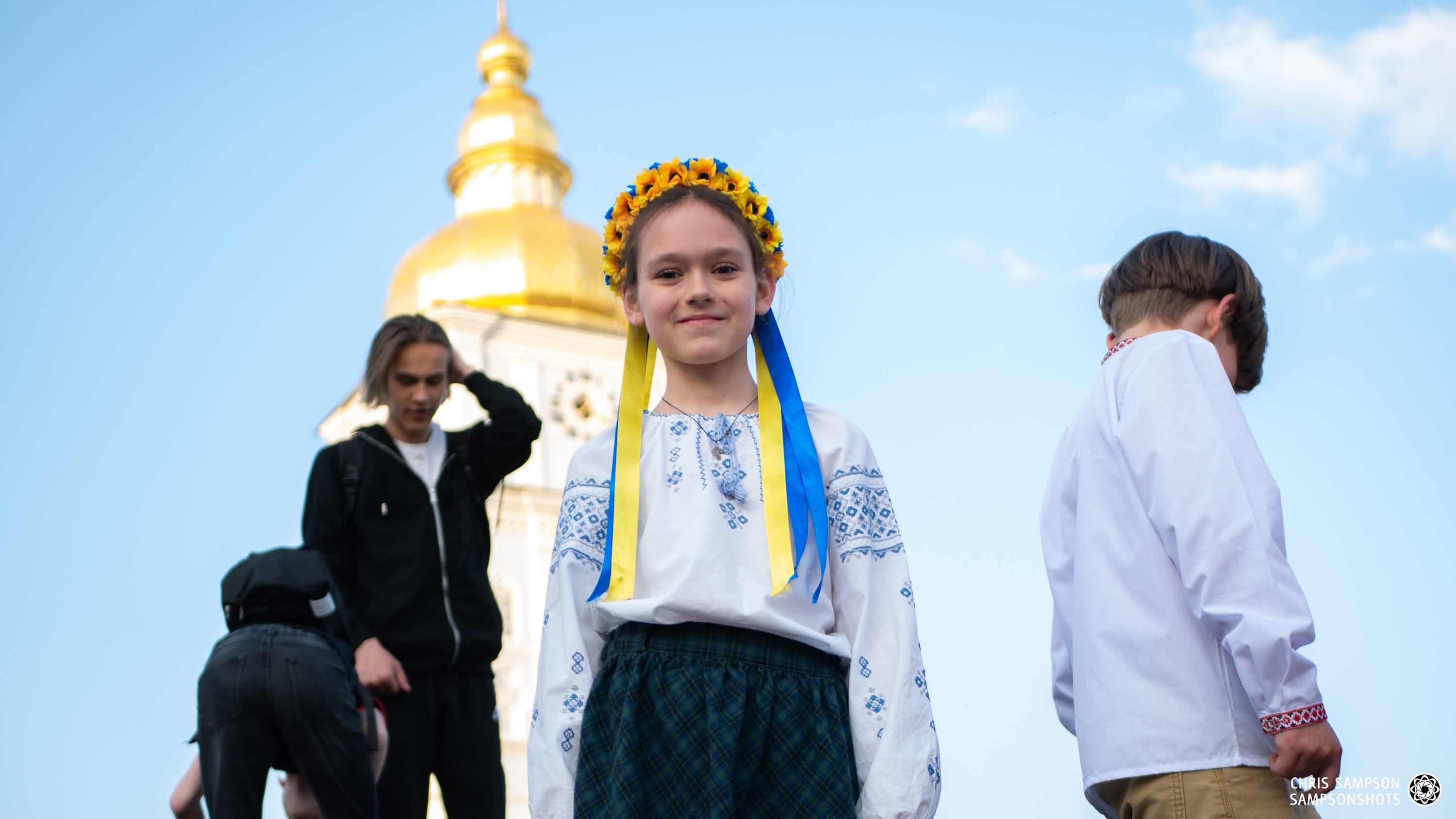
I’ve been in Kyiv since January of 2022, and I have been watching this city change its relationship to its own identity in ways that are both genuinely significant and, sometimes, very sad in a way I can’t fully articulate.
Some of what I’m watching is recovery.
The Ukrainian language has reclaimed ground in Kyiv faster in the past four years than in the previous three decades, because the war made the political implicit explicit. When Russia justifies its invasion partly by claiming Ukrainians and Russians are the same people, then the act of being recognizably Ukrainian — speaking the language, wearing the shirt, naming your child a Ukrainian name and not a Russified variant — becomes resistance by definition.
That is a genuine cultural renaissance born from catastrophe.
Some people are discovering their Ukrainianness the way you discover an ancestor you didn’t know you had — with genuine feeling, but also with the slight unreality of something constructed from documents rather than lived. You can’t hold that against them. The Soviet project worked on their parents and grandparents. The disconnection is real. The reconstruction is also real.
And some of what I’m watching is the particular exhaustion of people who have been carrying a thing their whole lives while the rest of the world finally notices it exists.
People who wore vyshyvankas before it was politically useful, who learned the stitches from women who risked things to teach them — there is something in how they wear their shirts today that is not quite pride and not quite grief. Something more like: Finally. Yes. This is what I was already telling you.
I don’t want to sentimentalize this. These contradictions are inside every living culture. What makes them sharp here is that they’re happening while the country is being shelled.
The attempt to erase Ukrainian identity is not a metaphor and it is not ancient history. It is the operational context of the current war.
The most famous episode is the Holodomor — the engineered famine of 1932–33 in which somewhere between 3.5 and 7 million Ukrainians died, depending on the methodology, in a country where the grain harvest had been deliberately seized by Soviet authorities even as people were dying from hunger in the villages that produced it.
The Holodomor targeted with particular ferocity precisely the communities that were guardians of Ukrainian folk culture — the rural peasantry of central and eastern Ukraine, who embroidered their shirts in regional patterns and spoke Ukrainian and maintained traditions that Soviet ideology identified as obstacles to collectivization and Russification.
The famine came after the Executed Renaissance.
That was the decade of the 1920s and early 1930s during which Ukrainian modernist culture had briefly flourished, producing writers, poets, artists, and intellectuals of genuine distinction — most of whom were subsequently arrested, shot, or driven to suicide during the Stalinist purges.
Mykola Khvylovy, one of the defining literary voices of the movement, killed himself in 1933 after the arrest of his colleagues. Les Kurbas, the director whose theater practice influenced European avant-garde performance, was executed in 1937 at Sandarmokh. The sculptor Ivan Kavaleridze survived by abandoning his Ukrainian themes. The poet Volodymyr Sosiura wrote a poem called “Love Ukraine” in 1944 and was denounced for bourgeois nationalism.
The charge was: loving Ukraine was, in the Soviet framework, a political offense.
This is the genealogy of the vyshyvanka in a drawer. Not always illegal to own — just inadvisable to display. Just the kind of thing that could prompt a question from a neighbor, and in 1950s Soviet Ukraine, a question from a neighbor could become a conversation with an official.
That drawer is the direct ancestor of today’s street festival.
The Russian Federation’s current war operates within a recognizable tradition of this project, updated for the twenty-first century and stripped of the ideological scaffolding of communism, replaced with the scaffolding of imperial nostalgia and Orthodox civilizationism.
Putin said explicitly, in the essay he published in July 2021 — which functioned as something between a manifesto and an operational order — that Ukrainians and Russians are “one people,” that Ukrainian national identity is an artificial construction, and that the Ukrainian state as it currently exists is a historical error.
The invasion that followed in February 2022 was, among other things, the military expression of a historiographical argument: you don’t really exist, so you can’t really be harmed by being incorporated.
What happened in Mariupol is the evidence against that argument. What happened in Bucha. What happened in Izyum, where I went in the weeks after liberation in September 2022, walking through streets where Russian forces had torn down Ukrainian-language signs and replaced them with Russian ones, had looted the library and destroyed the local history archive, had shot the people who resisted and buried them in the woods outside town.
These are not the acts of an army that believes it is reuniting one people.
These are the acts of an army that understands perfectly it is fighting a distinct and resistant civilization, and has decided to respond to that resistance by attempting to destroy the civilization.
The cultural destruction is systematic and documented. Russian forces have damaged or destroyed more than a thousand cultural heritage sites in Ukraine — museums, churches, archives, libraries, theaters, monuments.
The Mariupol Drama Theater, where civilians sheltered and painted the word CHILDREN in large letters on the ground outside, bombed. The Odessa Museum of Fine Arts damaged by drone strikes. The Transfiguration Cathedral in Odessa — a nineteenth-century structure of considerable architectural significance — partially collapsed by missile strikes. In the Kharkiv region, Russian forces targeted the Skovoroda Museum, burning it after the Russian army had already withdrawn. Which suggests the burning was deliberate rather than incidental to combat.
They are not destroying these things because they have no military value.
They are destroying them because culture is a vector of continuity, and continuity is the enemy of conquest.
By eleven in the morning the embroidery has migrated from the metro platforms to the streets of the center.
On the pedestrian section of Khreshchatyk, families are promenading with the specific formality Ukrainians deploy for occasion and dress-up — children walking with the careful posture of people who have been told not to get dirty, elderly couples in matching embroidered dress who have clearly done this together for thirty, forty years. Younger people in modern adaptations: vyshyvanka-print T-shirts, embroidered bomber jackets, the pattern applied to denim and athleisure in ways that feel like the natural result of a living tradition entering the mainstream rather than remaining in the museum.
There are soldiers. Some on leave. Some with the particular quality of presence that distinguishes men who are leaving from men who have returned — a remoteness behind the eyes, the way a body holds itself when it knows what it is returning to.
Some wear vyshyvankas over civilian clothes. Some have embroidered patches on military kit.
The embroidery doesn’t soften the context. It just shares the same body with it.
There is an argument — made in certain academic contexts and used instrumentally by Russian state media — that Ukrainian identity is a recent construction, that the vyshyvanka is an invented tradition in the Hobsbawm sense, assembled from folk parts to serve a nineteenth-century nationalist project.
Even in its most charitable version, this argument confuses origin with legitimacy.
All nations construct themselves from available materials. The question is not whether the construction happened but what it produced and who consented to it.
What Ukrainian culture produced, over several centuries of piecemeal and disrupted development — under Lithuanian, Polish, and Russian imperial jurisdiction, through the brief independence of 1918–1921, through the Soviet period, through independence from 1991 — is something that feels, to me as someone who has spent years paying close attention, like a civilization that has been making itself under adverse conditions for a very long time and has gotten quite good at making do with what it has.
Which includes thread.
The literal process of the vyshyvanka — needle, thread, cloth, time, hand — is the material version of what the holiday is actually celebrating: continuity. The threading of one generation through the eye of the next.
What is remarkable is not that this survived. Things survive. What is remarkable is how.
The Soviet state was formidable at cultural suppression. It had the coercive apparatus of a totalitarian system, the economic leverage of collectivization, the institutional reach to determine what was taught in schools and published in books and broadcast on radio.
And still, the patterns survived.
In drawers. In the memories of old women in villages. In the practice of embroidery itself, which was so domestic, so feminine, so apparently apolitical — just handicraft, just decoration — that the surveillance state couldn’t quite justify banning needlework.
Empire tends to underestimate what it cannot classify as a weapon.
A woman teaching her daughter a stitch pattern in a kitchen is not, by any operational definition, a threat to state security. She is just sewing. Except that the stitch pattern she’s transmitting is the coordinate of a specific place, a specific people, a specific way of understanding who you are and where you come from — information carried in the body as muscle memory rather than written down anywhere that could be confiscated.
Which turns out to be nearly impervious to destruction.
Russia is making the same mistake now. Bombing museums and archives because material culture is fragile. Missing what the Soviet state also eventually missed: the things you carry in your hands, in your gestures, in the half-unconscious knowledge of how to do something — those are much harder to destroy.
There are things Vyshyvanka Day cannot hold and should not be asked to hold.
It cannot hold grief at the scale Ukraine is now carrying. The displacement figures — close to eight million Ukrainians outside the country, millions more internally displaced — are statistics that only become real when you know specific people inside them.
Families split across three countries. Marriages that survived Maidan and the first occupation and didn’t survive the full-scale war, not because of any dramatic event but because of sustained pressure measured in years apart. Children growing up in Polish cities or German towns or Canadian suburbs who will speak Ukrainian with an accent their grandparents won’t fully recognize.
That is a form of cultural destruction too, quieter than a missile strike: the diaspora, the scatter, the children who will come back someday and find the country different from the one in their parents’ memories, which was already different from the one in their grandparents’ stories.
The vyshyvanka survives. The specific, accumulated, unrepeatable texture of a life lived in one place does not always survive.
It cannot hold the particular weight carried by military families who are here today and whose attention, whatever their physical location, is somewhere on the line running from Zaporizhzhia to Kharkiv.
Being present — buying flowers, drinking coffee, wearing your grandmother’s embroidered blouse on a spring Thursday — is not the opposite of war. It happens inside the war. The sirens are inside the holiday. The holiday is inside the sirens.
These things are not alternating. They are simultaneous.
It cannot hold the exhaustion. The Ukrainian exhaustion I’ve been watching accumulate since 2022, which is not despair — I want to be precise about this — but is something more like the change in a person who has been running for four years and has decided to keep running but no longer wastes energy on the performance of being fine.
People here are less performatively cheerful than they were in 2022. They are also, in some ways I find harder to explain, more solid. The sentimentality burned off. What remains is more durable.
What a holiday is actually doing in the economy of a civilization is providing, briefly, a register in which continuity is more visible than rupture. Not denial. Not suppression.
Just: this thread predates the current catastrophe, and it will still be here when the catastrophe ends.
That is not small. That is, in fact, quite large.
The Maidan memorial wall on Instytutska Street is covered in flowers today, as it often is, but more so.
The photographs of the Heavenly Hundred — the protesters killed in 2014 — are hung in their usual places. Around them people have tucked fresh flowers, small embroidered patches, handwritten notes. The photographs are mostly young faces. The notes are in Ukrainian. The embroidery on the patches is careful work, the kind that takes time.
I walk through Podil in the late afternoon, when the light comes at the low angle that makes Kyiv look like a city that has always existed at the edge of something important, which it has.
In Podil the vyshyvanka density is different than in the center — more casual, less ceremonial. People going about their Thursday in embroidered shirts the way you’d wear a good linen shirt on a warm spring day, as though the garment were simply clothing rather than statement.
Which is perhaps the more interesting version. Not I am making a point today. Just: this is what I wear.
By evening the streets have thinned. The formal performances are over — the folk music in the parks, the children’s processions, the official photo opportunities. What remains is the casual evening city with a higher than usual density of embroidered sleeves visible in restaurant windows and café terraces.
The night is warm. The air carries the smell of linden blossoms, which always hits me with a specific emotional impact I can’t quite name — it’s the smell of Kyiv in the season when it decides to be beautiful, regardless of what else is happening.
Somewhere across the city a phone alerts.
Someone glances at it, puts it back in their pocket, keeps talking.
The thread holds.
Chris Sampson is Editor-in-Chief of NatSecMedia and host of The Wire Tap on Substack. He has reported from Ukraine since January 2022.
Before I started this comment, I read John's comment below. His comment is very insightful.
I would just say that your story is very a interesting picture of the brave society that we admire from afar but actually know so little about.
Reading it makes me recall reading the book "Bloodlands" by Timothy Snyder and the incredulity I felt absorbing the horrors of Stalin, the murders, the starvation. It makes you wonder why Hitler gets top billing as the worst monster ever? Digressing a bit, the Japanese probably killed even more in their conquests. Probably Hitler gets top billing because the allies made a deal with the devil to defeat Hitler. And now the Russians are back under Putin.
On the upside, CNN reported this morning that Ukrainian drones/missiles hit a Russian drone manufacturing facility inside Russian that killed 69. I think they also commented that Ukraine seemed to be winning at the moment. That is not a quote just the gist of it. I know from your substack that there is always a lot going on in Ukraine but after extensive coverage in the beginning not much is breaking through in mainstream USA coverage.
Thanks for all you do. You are definitely a one of a kind.
Way too much to consume in one sitting based on the amount of content and emotions inside them, but this stood out to me:
“The attempt to erase Ukrainian identity is not a metaphor and it is not ancient history. It is the operational context of the current war.”
Powerful.
The history captures what my Ukrainian colleague said to me the week the attacks started in February 2022: “Russian soldiers are Vodka drinking murderers.”
True before, true today?
Is the alcohol to numb the pain or strengthen their courage?
Is the alcohol to blind their faith in their government, or to simply zone out from its control?
Is the US on this same path with a third being blinded, zoning out, and/or wanting to be controlled, or worse yet, control of others?
Thanks for the written word.