
THE TOUR GUIDE
How Russia Walked Sanctioned Officials Through the United States Capitol — and Why Anna Paulina Luna Was the Perfect Host

DEAR READER: Please consider a basic support membership at $5 per month if this work matters to you. As a journalist in Ukraine, I report every day—even during blackouts and drone attacks—from the fulcrum of where this war is unfolding, and your support makes that possible. Today is my 1451th day in this 1497th of full-scale war (4423 since 2014), and independent journalism is not cheap to sustain. I will continue making these posts available to all readers, even during nearly 24 hr daily blackouts, but this work depends on those willing to support it, and I am deeply grateful to those who do. – Chris Sampson, Kyiv, April 1, 2027
On the evening of March 26, 2026, a group of Russian State Duma members — every one of them under U.S., EU, UK, Japanese, and Australian sanctions for their role in supporting the full-scale invasion of Ukraine — were given a private tour of the United States Capitol.
Their guide was Rep. Anna Paulina Luna, Republican of Florida.
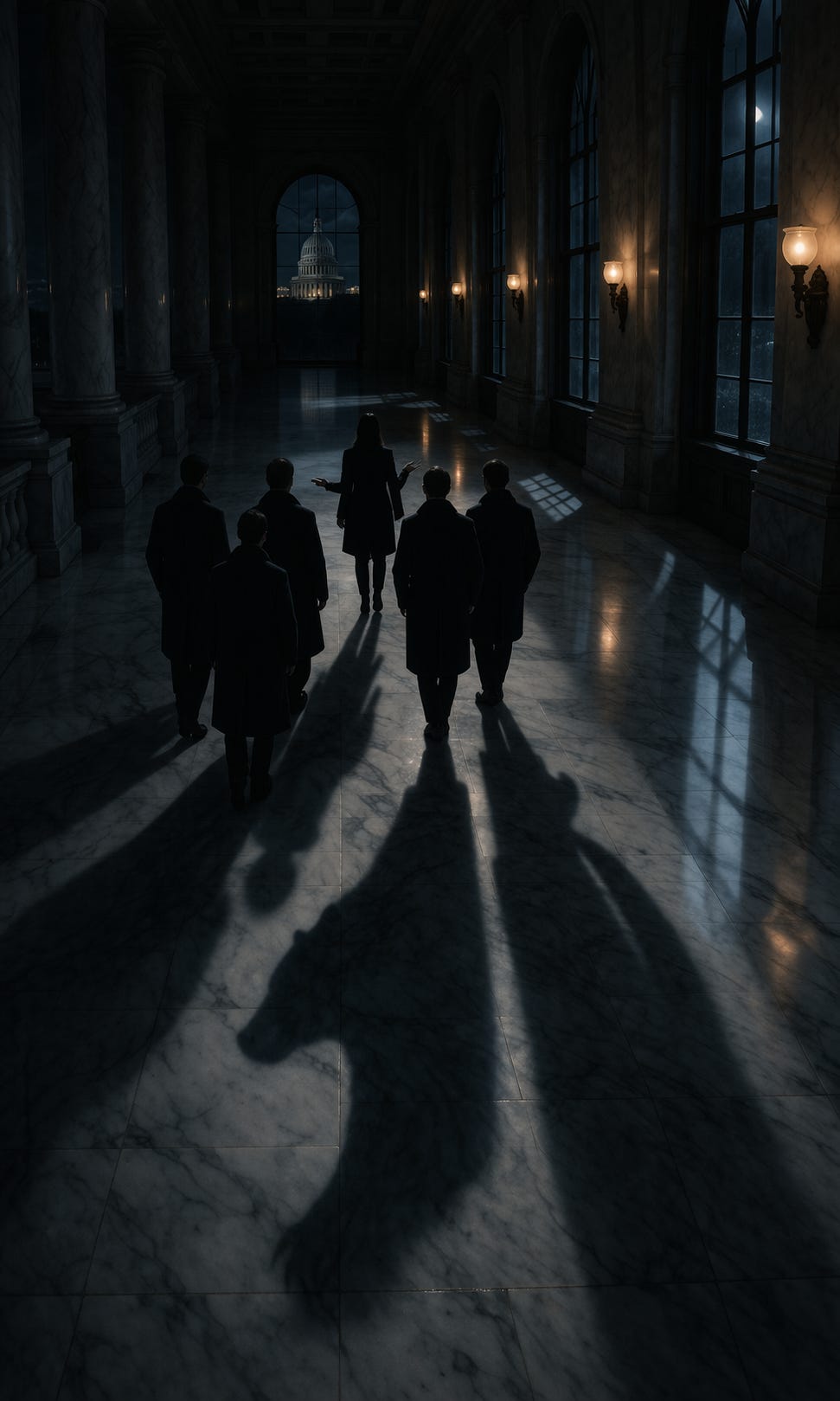
They moved through the building’s corridors, strolled the halls of the legislature of the nation that had spent four years supporting Ukraine’s survival, and according to a congressional aide cited by The Hill, at one point passed through Speaker Mike Johnson’s suite of offices via the balcony — unannounced, and without the Speaker present.
Kremlin envoy Kirill Dmitriev, who had met with Luna in Florida in October 2025 and publicly coordinated with her in the months preceding the visit, called it “historic” when he shared her post on X.
He was right. Not in the way he meant it — or perhaps exactly in the way he meant it.
This article is about that tour. But it is about something much older and much larger than a single evening’s walk through marble corridors. It is about the doctrine that made that evening possible, the profile of the person who made it happen, and the institutional architecture of influence operations that aligned a Florida congresswoman’s genuine beliefs with Russian strategic objectives — without requiring her to know, or care, whose interests she was serving.
It is about a machinery that, according to defector testimony and declassified archive material, has been running continuously since at least 1967. And it is about the specific kind of person that machinery is designed to find, cultivate, and use.
PART ONE: THE DOCTRINE
What Active Measures Actually Are
There is a phrase in Russian intelligence doctrine — aktivnyye meropriyatiya — that has no precise English translation. Former U.S. Under Secretary of State Lawrence Eagleburger noted this when discussing why the concept was so difficult for Americans to grasp. He wasn’t being evasive. He was being accurate.
Active Measures are not propaganda, though propaganda is a component. They are not disinformation, though disinformation is a tool. They are not influence operations in the way Western democracies understand that term — bounded, contextual, subject to legal oversight, dissolved when the emergency that justified them ends.
Active Measures are a comprehensive doctrine for operating permanently in the adversary’s political environment as operational terrain. A KGB definition from the 1970s, drawn from files held in the Estonian National Archives and analyzed by Baltic security researchers, is direct: “agent-operational measures aimed at exerting useful influence on aspects of the political life of a target country which are of interest, its foreign policy, the solution of international problems, misleading the adversary, undermining and weakening his positions, the disruption of his hostile plans.”
The word that matters most in that definition is permanent. There is no peacetime in this doctrine. There is no off-season. The operations run continuously, across generations of practitioners, through political transitions in both Russia and the target country, adapted to available technology but unchanged in strategic purpose.
Robert Gates, testifying to Congress in 1992, offered the closest American approximation: “covert operations designed to shape public opinion in foreign countries on key political issues, targeted at opinion-makers, such as political leaders, the media, and influential businessmen, as well as the public at large.” What his formulation did not fully capture was the scale — by 1982, CIA Deputy Director John McMahon estimated Soviet Active Measures cost between $3 and $4 billion annually — or the permanence. Gates described a program. The doctrine describes a generational institutional commitment.
Yuri Bezmenov, a KGB propaganda officer who defected in 1970 and spent the following decades describing from the inside what he had practiced from the outside, estimated in a 1984 interview that 85 percent of KGB resources — time, money, personnel — were devoted not to espionage but to what he called “ideological subversion.” Not stealing secrets. Reshaping how Western publics think about their own governments, institutions, and adversaries.
Eighty-five percent. Of the world’s most powerful intelligence service.
Not collecting intelligence.
Changing minds.
The Mechanism: How It Actually Works
The doctrine’s operational genius — and this is the aspect that most Western analyses consistently underweight — is that at its most effective, it does not require recruited agents or paid assets. Its most powerful instrument is the unwitting amplifier: the person who genuinely believes what they are saying, whose sincerity makes them far more persuasive than any manufactured voice could be, and who arrives at their beliefs through an information environment that has been shaped, over time, to produce exactly those conclusions.
In the KGB’s operational lexicon, this person was described using a phrase commonly attributed to Lenin, though its precise origin is disputed: “useful idiot.” The phrase has been diluted through decades of casual political usage. In its operational context, it is not an insult. It is a functional classification. It describes a person whose sincere convictions align with the adversary’s strategic objectives and who can therefore be used — without payment, without coercion, without their knowledge — to advance those objectives through channels that paid agents could never access.
A lawmaker who accepts money from a foreign government is a spy. Identifiable, prosecutable, removable.
A lawmaker who sincerely believes the narratives that a foreign government has spent years manufacturing and distributing — who repeats those narratives as their own independently arrived-at conclusions, on their own platforms, to their own constituents — is something considerably more valuable and considerably harder to counter. They carry institutional credibility. They carry democratic legitimacy. Their voting record cannot be attributed to foreign direction. And they are, in the counterintelligence sense, deniable.
The doctrine does not require conspiracy. It requires only the right person in the right information environment at the right moment.
Which brings us to Anna Paulina Luna.
PART TWO: THE TARGET PROFILE
Who Gets Chosen
Before examining Luna’s specific record, it is worth establishing what the historical documentation shows about the characteristics Russian intelligence has consistently sought when identifying Western politicians suitable for active measures cultivation.
The Mitrokhin Archive — the most comprehensive primary source record of Soviet active measures operations, smuggled out of KGB headquarters by senior archivist Vasili Mitrokhin when he defected to British intelligence in 1992 and analyzed in detail by historian Christopher Andrew — shows consistent operational patterns across decades. Based on that record, cultivatable targets tend to share several characteristics.
Genuine ideological alignment with Russian strategic narratives. Not manufactured loyalty — authentic, pre-existing belief in the narratives Russia wants amplified. The person already holds views that serve Russian interests, arrived at independently, which means they will defend those views against accusations of foreign influence with the full force of sincere conviction.
Access to high-value platforms and audiences. The narrative requires a delivery mechanism. A congressional seat, a significant social media following, a position on committees with oversight of foreign policy or intelligence — each multiplies the operational value of the contact.
Responsiveness to flattery and the appearance of significance. The Mitrokhin Archive documents this pattern consistently across KGB Third World operations and Western influence campaigns alike: the unwitting asset responds to being treated as a historically important figure by senior foreign officials, as a person entrusted with information that lesser players don’t receive, as a peacemaker and statesperson operating above the narrow concerns of the mainstream. The self-image of the asset is the lever.
Pre-existing distrust of the intelligence community and mainstream press. This is the crucial defensive characteristic. When counterintelligence officers, journalists, or colleagues raise questions about Russian contacts, the asset’s genuine institutional distrust means they are more likely to interpret such warnings as confirmation of a “deep state” campaign against them than as legitimate concerns. The distrust functions as inoculation against detection and correction.
Institutional positioning in areas Russia needs to access or normalize. Committee assignments, oversight roles, the capacity to convene meetings, extend invitations, provide access to spaces — the Capitol, a legislative chamber, an official’s suite — that Russian officials cannot reach through normal diplomatic channels, particularly when those channels have been constricted by sanctions.
Read that profile and then look at the publicly documented record of the past eighteen months.
The Record
Luna serves on the House Committee on Foreign Affairs and the House Committee on Oversight and Government Reform. In February 2025, Speaker Mike Johnson appointed her to chair a House Oversight Task Force on declassification of federal secrets — a position that gave her formal institutional standing to approach foreign governments for archival materials and put her in regular contact with classified document processes.
In October 2025 — according to statements from both Luna and the Russian Embassy — Ambassador Alexander Darchiev received Luna at his personal residence in Washington. At that meeting, Darchiev handed her a 350-page document that the Russian government described as an archive of declassified Soviet records on the assassination of President Kennedy.
Read that carefully. A sitting U.S. congresswoman who chairs a task force on federal secrets declassification, and who serves on the Foreign Affairs Committee, was received at the Russian Ambassador’s private residence and handed Russian intelligence materials on the most durable and consequential assassination conspiracy in American history.
Marc Thiessen, the conservative Washington Post columnist, observed when the story broke: “Zero chance the Russians are laughing at you.”
The JFK documents are, from an active measures analytical standpoint, a remarkably efficient instrument. They simultaneously revive and legitimize a conspiracy narrative that — according to the Mitrokhin Archive documentation analyzed by Christopher Andrew — traces its institutional origins to a KGB operation launched within weeks of Kennedy’s assassination in November 1963. That operation funded the publication of Oswald: Assassin or Fall-Guy? through Soviet-subsidized publisher Carl Marzani (codenamed NORD in KGB files), channeled funds and Soviet journalistic contacts toward Mark Lane’s research, and eventually produced Operation ARLINGTON — a forged letter in Oswald’s handwriting designed to implicate the CIA in the assassination. For six decades, that narrative infrastructure has continued generating amplification without requiring active maintenance.
The documents also place Luna in a position of apparent special access to Russian intelligence, flattering her self-image as a diplomatic pioneer. They generate favorable coverage in Russian state media. And they deepen a working relationship with the Russian Ambassador that Moscow will continue to develop.
Luna described the documents publicly as being of “massive historical significance.”
In December 2025, the Russian Embassy announced on its official Telegram channel that Ambassador Darchiev attended Luna’s Christmas reception on Capitol Hill. The Embassy described it as a “wonderful event with warm atmosphere and exceptional hospitality” and closed with: “Continue working to make Russian-American relations great again!”
Ambassadors of adversary nations do not attend random congressional holiday parties. The phrase “continue working” is a statement of ongoing operational relationship, not pleasantry.
In October 2025, Luna quoted Putin’s economic envoy Kirill Dmitriev on her X account, amplifying his messaging to her followers. In late October, according to TASS and public statements from both parties, she met with Dmitriev in Florida to discuss what was described as “continuing Russia-U.S. dialogue.” Dmitriev praised her publicly as “an outspoken advocate for peaceful solutions.” Luna said the meeting was productive and that they had “identified common ground.”
Then, in August 2025, she posted to X that Ukrainian President Zelensky was “wiring $50 million a month to some Saudi bank” — apparently confusing the UAE with Saudi Arabia in the process. The claim was false. It originated, according to NewsGuard’s documented forensic analysis, on a fringe Turkish outlet called Aydınlık, which Georgian fact-checkers at Myth Detector have identified as a vehicle routinely used by Russian state media to launder disinformation by citing it as an independent “foreign source.” That is precisely what happened: within 24 hours of the Aydınlık publication, TASS, Sputnik, and RIA Novosti ran the claim. It was then aggregated by Microsoft’s MSN platform. Luna found it on MSN and posted it to her followers as if it were established reporting. Russian state media subsequently ran coverage citing Luna as the authority: “According to U.S. Congresswoman Anna Paulina Luna, Zelensky sends approximately $50 million monthly to an anonymous Saudi bank.”
The feedback loop was complete. A fabricated narrative left a fringe source, traveled through Russian state media, gained mainstream-adjacency through an aggregator, acquired congressional endorsement from a U.S. lawmaker, and returned to Russian state media wearing that endorsement as proof of Western acknowledgment.
When NewsGuard sought comment, Luna’s spokesman David Leatherwood responded: “The news source Rep Luna was referencing was MSN. If you have an issue with their reporting, take it up with them.”
This is not the response of a person who understands what happened. It is the response of a person who is entirely sincere — and therefore entirely useful.
The broader legislative record is consistent with the pattern. Luna has co-sponsored legislation calling for the suspension of all U.S. military assistance to Ukraine. She has advocated for U.S. withdrawal from NATO. She has characterized concerns about Russian interference in U.S. politics as a fabricated “deep state” narrative. When journalists have raised questions about her interactions with Russian officials, she has described them as “war pimps” running “smear campaigns” on behalf of a “pro-war machine.” When Politico Europe reported on aspects of Dmitriev’s diplomatic activities, Luna publicly defended Dmitriev and characterized the outlet as a “mouthpiece for the pro-war machine in Ukraine.” Dmitriev, according to TASS reporting, thanked her for the advance warning.
She is not a spy. Nothing in the public record supports that conclusion, and this article does not make it. She appears, based on the public record, to genuinely believe what she says.
That is precisely the point.
PART THREE: THE DELEGATION
Why That Specific Group
Understanding the composition of the Duma delegation that walked through the Capitol on March 26 requires understanding how Russia staffs this category of operation.
The delegation was led by Vyacheslav Alekseyevich Nikonov, described in his official biography and public records as a senior member and former chair of the Duma’s Foreign Affairs Committee. His personal history is worth examining in full, because it is a compressed institutional history of the Soviet security apparatus and its continuity into the present.
Nikonov is the grandson of Vyacheslav Molotov — Stalin’s foreign minister, co-author of the Molotov-Ribbentrop Pact with Nazi Germany, a man who, according to historical records, co-signed death warrants for thousands during the Great Purge. His father was, according to Putin’s List — a sanctions accountability database — an NKVD officer. Nikonov grew up within the innermost circle of Soviet power. He graduated from Moscow State University’s history department, where his doctoral thesis — which he completed in 1989, making him at that time the youngest Doctor of History in the USSR — focused on the history of the Republican Party in the United States. That specific research focus is worth noting in context.
In 1991, according to his own official biography published by the Russian International Affairs Council, he served as assistant to the head of the Presidential Administration of the USSR. Then, following the failed August 1991 coup, he served as assistant to the chairman of the State Security Committee — the KGB — in the final months of its existence.
He was KGB staff. This is not an inference or an allegation. It is in his own official biography and independently confirmed by multiple institutional databases.
The Center for European Policy Analysis, in its March 2026 analysis of the delegation, described Nikonov accurately as having “learned the rules of the Kremlin game from childhood” and as embodying what CEPA characterized as a family tradition of institutional service to Russian leadership across successive regimes. His post-Soviet trajectory traces directly through the Russkiy Mir Foundation, which Putin established by presidential decree in 2007 and which Nikonov has chaired since that year.
The Foundation is frequently described in its public materials as a cultural and educational organization analogous to the British Council or the Goethe Institute. What it actually functions as, according to EU sanctions designation documentation, is an arm of Russian state foreign policy — financed from the federal budget, reporting to the Ministry of Foreign Affairs and the Ministry of Education, designated by the European Union for sanctions in July 2022 for “disseminating pro-Kremlin and anti-Ukrainian propaganda” and “justifying Russia’s military aggression against Ukraine.” Ukraine’s security services have separately identified it as a vehicle through which Russian intelligence services have operated under cultural cover.
The Free Russia Foundation — a Washington-based organization of Russian opposition figures in exile — analyzed the delegation and noted in a public statement that Nikonov’s leadership of it “suggests formal authorization for the Russian lawmakers to engage in talks rather than an informal or exploratory exchange.” This was not, by any structural analysis, a freelance mission. It was a state-sanctioned diplomatic operation that required a U.S. congressional host to achieve access it could not obtain through normal channels.
The other delegation members were drawn from across Russia’s nominal political spectrum — Communist, Liberal Democratic, Just Russia, United Russia — in a configuration that analysts at the Free Russia Foundation described as designed to project an image of Russian democratic pluralism. The analytical inference, consistent with historical active measures practice documented in the Mitrokhin Archive, is that this cross-party composition was intended to make the visit appear to represent broad Russian democratic governance rather than a coordinated Kremlin foreign policy operation. Every member was under EU sanctions; several carried additional designations from the UK, Japan, Australia, and others.
Svetlana Zhurova — United Russia, former Olympic speed skater, Duma Foreign Affairs Committee member — acknowledged to reporters it was her first time at the Capitol. Boris Chernyshov of the Liberal Democratic Party of Russia stated to Russian media that the delegation’s primary goal was “conveying our position, the truth,” and added: “We succeeded.” Mikhail Delyagin, a nationalist economist, is a regular contributor to Russian state propaganda outlets. Vladimir Isakov of the Communist Party completes what the Free Russia Foundation called the “pluralism display.”
Ambassador Alexander Darchiev — the official who received Luna at his residence in October 2025, handed her the JFK documents, and attended her Capitol Christmas reception in December — was also present at the March 26 meeting.
Rep. Derrick Van Orden of Wisconsin, one of four U.S. legislators who joined the meeting at Luna’s invitation, told The Hill: “They’re just people — I mean they’re diplomats, one guy I guarantee he used to be a KGB agent. That’s a very good, educated guess. But pleasant enough.”
One imagines the officer in question was.
PART FOUR: THE OPERATION INSIDE THE OPERATION
The JFK Gambit — The Operation That Never Closed
Among those with working knowledge of active measures history, the JFK document transfer is the element of this case that reveals how deep the operational continuity runs.
What happened in October 2025 is not new. It is a documented continuation of a KGB influence operation that the Mitrokhin Archive traces to the weeks immediately following Kennedy’s assassination in November 1963.
According to Andrew and Mitrokhin’s analysis of the archive, the original KGB operation identified the Texas oil right as responsible for the assassination through what documents describe as “a reliable source of the Polish friends.” Carl Marzani — codenamed NORD in KGB files, identified by Andrew and Mitrokhin as “probably recruited before the Second World War” — was running the Liberty Book Club and its commercial affiliate with approximately 7,000 members. In May 1960, the International Department of the Central Committee had approved a $15,000 grant to keep Marzani’s operation financially viable; by September 1961, a further $55,000 allocation followed. That infrastructure was in place when Kennedy was killed. Marzani published Oswald: Assassin or Fall-Guy? within weeks of receiving the manuscript. Mark Lane’s Rush to Judgment — the number-one hardback bestseller of 1966 — was developed with Soviet journalistic contacts and funding channels that Andrew and Mitrokhin document in detail. Operation ARLINGTON subsequently produced a forged letter in Oswald’s handwriting designed to imply CIA involvement in the assassination. For six decades, the narrative architecture constructed in those early months has continued generating amplification through successive cycles of American political crisis, requiring minimal active maintenance.
Vyacheslav Nikonov — grandson of Molotov, former KGB assistant, chairman of the Russkiy Mir Foundation — walks into the United States Capitol in March 2026 on a congresswoman’s invitation. Three months before that, Ambassador Darchiev was at his residence handing the chair of a congressional declassification task force a 350-page Russian intelligence document on the Kennedy assassination.
The connective tissue is not circumstantial. It is operational.
Sergei Tretyakov, the SVR colonel who defected in October 2000 — his case documented in detail by journalist Pete Earley in Comrade J, based on extensive direct access to Tretyakov — confirmed that Service A, the KGB’s dedicated active measures department, was never disbanded following the Soviet collapse. It was rebranded internally as “Department MS — Measure of Support.” The officers transferred. The operational files transferred. The doctrine transferred with them.
The KGB operation from 1963 did not end. It now has a congressional address book.
The Feedback Loop — The Zelensky Disinformation Case
NewsGuard’s documented forensic analysis of the Zelensky “$50 million” disinformation campaign, independently corroborated by Georgia’s Myth Detector fact-checking organization and Ukraine’s Center for Strategic Communications, is a near-perfect illustration of how Russian active measures function in the contemporary digital environment.
The documented chain: a fringe pro-Russian Turkish outlet publishes an unverified claim. Russian state media — TASS, Sputnik, RIA Novosti — immediately amplify it, citing the Turkish outlet as an independent “foreign source.” The story is aggregated by Microsoft’s MSN platform. A U.S. congresswoman with several hundred thousand followers encounters it on MSN and posts it as established fact. Russian state media then publish stories citing the congresswoman as their authoritative Western source.
The fabricated narrative traveled from a fringe source to a senior Russian propaganda official’s endorsement in the span of weeks — and it did so by routing through a sitting member of the United States Congress, whose institutional authority laundered the claim into something that “even American lawmakers” had confirmed.
The term for this in influence operations analysis is a feedback loop: the narrative returns to its source legitimized by its journey through Western institutions. RT published it as: “According to U.S. Congresswoman Anna Paulina Luna, Zelensky sends approximately $50 million monthly to an anonymous Saudi bank.”
When NewsGuard sought comment, Luna’s spokesman responded: “The news source Rep Luna was referencing was MSN. If you have an issue with their reporting, take it up with them.”
The deflection is itself diagnostic. The useful idiot is also, functionally, the instrument for discrediting the people trying to document the operation.
The Capitol Tour — Physical Access as the Objective
The March 26 evening tour accomplished something that social media amplification cannot: it placed sanctioned Russian officials — including a former KGB officer who currently chairs Russia’s primary international influence operation — inside the physical space of the United States legislature.
The operational value of this is multiple and layered.
The visit generated photographs and official documentation that Russian state media immediately framed as normalization — proof that “even the United States Congress” is engaging with Moscow, that the sanctions architecture is performance, that Western solidarity against the invasion of Ukraine is visibly fracturing. Kremlin spokesperson Dmitry Peskov had said before the meeting that Moscow “welcomes any efforts to revive dialogue.” Putin’s envoy called it “historic.” Russian state media ran sustained coverage.
The meeting also gave five Duma members — every one of them sanctioned, none of them formally authorized to conduct diplomatic engagement — direct conversational access to five sitting members of Congress, including their assessments of the internal political pressures on Ukraine policy, the divisions within the governing party, the legislative landscape for continued support. Conversations of that kind, conducted inside the Speaker’s suite, produce intelligence whether or not any participant intends them to.
But the element that received the least public attention may be the most consequential: according to reporting by The Moscow Times and other outlets, Nikonov stated publicly after the meeting that the two sides discussed the possibility of U.S. lawmakers making a reciprocal visit to Moscow. The Capitol tour, in this framing, is Phase One. Phase Two is American legislators in Moscow — on Russian terms, before Russian cameras, on Russian television — providing the normalization content the Kremlin needs for its domestic propaganda while the war it started continues to grind through Ukrainian cities.
PART FIVE: THE USEFUL IDIOTS IN HISTORY AND CONTEXT
The Spectrum from Idiot to Agent
Luna is neither the first nor the most consequential figure on this spectrum. Understanding her case requires situating it within the documented historical range that runs from the ideologically aligned, unwitting amplifier at one end to the recruited, witting, compensated foreign agent at the other.
At the witting agent end of that spectrum, the record is well known: Aldrich Ames, Robert Hanssen, the Cambridge Five — all of whom understood they were engaged in what their own governments would call treason and proceeded anyway for ideological or financial reasons. Carl Marzani understood he was receiving Soviet funding for his publishing operations. These are cases with clear legal and moral definition.
The useful idiot cases are less legally clear, more operationally potent, and considerably harder to counter.
Carl Sagan’s role in the KGB’s “nuclear winter” disinformation campaign of the 1970s and 1980s is instructive. According to Tretyakov, Service A manufactured and placed scientific material in the Ambio journal — published by the Royal Swedish Academy of Sciences — specifically because it would reach scientists with Sagan’s pre-existing anti-nuclear convictions. Sagan did not know the research had been shaped to reach him. He amplified it because it was consistent with what he already believed about nuclear weapons and atmospheric science. His credibility, earned over decades of legitimate scientific work, was the instrument. His sincerity was the proof of its value.
Mark Lane, the Kennedy conspiracy researcher, apparently had some awareness of Soviet-connected contacts but — according to Andrew and Mitrokhin’s analysis of the Mitrokhin Archive — almost certainly did not understand the full extent to which his research had been scaffolded by KGB direction and funding. His genuine conviction that he was uncovering a genuine American conspiracy made Rush to Judgment more persuasive than any document Service A could have manufactured directly.
Indira Gandhi — codenamed VANO in KGB files — became, in the assessment of Christopher Andrew and Vasili Mitrokhin based on the archival record, “unconsciously influenced by disinformation fabricated by Service A” and developed what the archive describes as an obsession with supposed CIA plots targeting her personally. She was not an agent. She was a leader whose beliefs had been carefully shaped. She believed she was protecting Indian sovereignty. The KGB believed she was protecting Soviet strategic interests. Both were correct.
In each case, the subject’s sincerity was the operational asset. The KGB was not searching for people willing to lie on behalf of Russia. It was identifying people whose genuine beliefs, when cultivated and channeled, produced outputs that served Russian objectives. The distinction is not merely moral — it is structural. A liar can be caught in a lie. A sincere person cannot.
The 2026 Ecosystem
What distinguishes the current moment is not that Russian active measures are targeting American politicians — the historical record shows they have been doing this continuously since at least the late 1940s. What distinguishes it is the convergence of two factors.
First, a domestic political environment in which a significant faction of the governing party has independently arrived at views — on NATO, on Ukraine, on Russian interference, on the intelligence community — that map closely onto the outputs that six decades of Russian active measures have been designed to produce. This creates what intelligence analysts call a target-rich environment: large numbers of politicians and commentators who can function as unwitting amplifiers without requiring individual cultivation, simply because the information ecosystem they inhabit has already shaped their priors in useful directions.
Second, a digital infrastructure that has eliminated the friction that previously constrained how quickly fabricated narratives could travel from their source to mass audiences. A KGB disinformation campaign in the 1960s required printing, postal distribution, newspaper placement, and weeks of propagation time. The Zelensky “$50 million” operation documented above moved from a fringe Turkish website to a U.S. congresswoman’s X feed to Russian state media cover stories in approximately three weeks. The doctrine did not change. The delivery cost dropped to near zero.
The other members of Luna’s congressional group — Van Orden, Ogles, Crane, and Democrat Gonzalez — are not, based on available public evidence, witting instruments of Russian intelligence. They are politicians operating within an information environment where the narratives Russian active measures have been cultivating for years have become the normalized baseline assumptions of a significant portion of their constituency.
Former Republican congressman Adam Kinzinger called them “traitors” on X. That characterization may be emotionally satisfying. It is analytically imprecise. What the historical record shows these individuals to be — in the operational sense — is useful: people whose genuine political commitments lead them to take actions that serve Russian strategic objectives without their awareness or consent.
The Turning Point USA “sovereignty” conference, at which Luna served as honorary chair and which drew far-right politicians and activists from across the Western world, illustrates the ecosystem infrastructure. Many of the movements represented — national sovereignty campaigns, anti-NATO formations, anti-Ukraine factions across Europe and North America — have been documented by European intelligence services as having received support from Russian state-adjacent sources. The organizational network functions as what analysts call a transmission belt: a self-sustaining ideological infrastructure that requires no direct coordination from Moscow because it has already internalized the objectives Moscow wants advanced.
None of the participants require a phone call from the Kremlin. The information environment was built so they wouldn’t need one.
PART SIX: WHY IT WORKS — AND WHY IT’S HARD TO STOP
The Problem with “Useful Idiot”
The term carries a rhetorical liability: it sounds contemptuous, which makes the people it describes defensive, which makes them less likely to examine their situation, which makes them more useful.
A more operationally precise formulation would be: a person whose genuine beliefs have been shaped by an adversary’s influence operations to produce outputs that serve the adversary’s strategic objectives, who believes they are acting entirely on their own convictions, and whose sincerity provides the deniability that makes the operation sustainable.
That formulation is harder to dismiss. It is also considerably harder to hear.
The structural problem with countering this category of influence is that the counter-argument — “your relationship with Russian officials is producing outcomes that serve Russian strategic objectives” — sounds, to the subject, indistinguishable from what a “deep state” operation designed to silence honest peacemakers would say. This is not accidental. The active measures doctrine, documented across decades of KGB operations in the Mitrokhin Archive, specifically cultivates in its targets the institutional distrust that will inoculate them against exactly this accusation. By the time the relationship is established and producing results, the subject has already been primed to interpret counterintelligence concerns as confirmation of the conspiracy they have already been told is being run against them.
Luna’s response to the backlash over the Capitol tour was to characterize her critics as “war pimps” seeking to undermine peace, to repeat the claim — contradicted by fact-checkers — that Ukraine had misappropriated American funds, and to describe the visit as “historic” in positive terms. Kirill Dmitriev’s response to the same backlash, posted to his X account according to TASS, was to state that “warmongers attack the US-Russia parliamentary meeting because they want the Ukraine conflict to continue and are afraid of any US-Russia dialogue.”
Their public messaging was functionally identical. There is no public evidence they coordinated it. They didn’t need to.
The Sanctions Waiver Question — The Silent Enabler
The delegation’s presence in Washington required the State Department to formally waive U.S. sanctions on every member of the Russian Duma group. Entry without a waiver would have been illegal under sanctions law. Someone in the Trump administration authorized those waivers.
Representative Brian Fitzpatrick, the Pennsylvania Republican who co-signed the bipartisan letter demanding answers from Secretary Rubio and Treasury Secretary Bessent, put the legal and policy stakes plainly: “Because these individuals are subject to U.S. sanctions imposed in response to Russia’s full-scale, unjustified invasion of Ukraine, their entry into the United States would have required the issuance of sanctions waivers.”
As of this writing, neither the State Department nor the Treasury Department has publicly explained who authorized those waivers, under what legal authority, or what review process concluded that allowing sanctioned Russian officials to tour the United States Capitol served American national security interests.
This question extends well beyond the Luna case. If the sanctions architecture — the principal non-military instrument of Western pressure against Russia’s ongoing occupation of Ukrainian territory — can be quietly suspended at the informal request of a junior member of Congress who has spent eighteen months in documented contact with the Russian Ambassador, the Russian Economic Envoy, and senior Duma officials, then the deterrent value of sanctions as a policy instrument collapses. The lesson the Kremlin extracts from this is that cultivating congressional access is more effective than any diplomatic channel — and that the investment in Anna Paulina Luna has produced returns that professional Russian diplomacy, operating under sanctions restrictions, could not have achieved on its own.
PART SEVEN: THE ACTIVE MEASURES FRAMEWORK — WHAT WE NOW KNOW
Reading the Luna Relationship Through the Doctrine
Step back from the individual incidents and apply the analytical framework that the historical record of Soviet and Russian active measures provides — drawing on the Mitrokhin Archive, Andrew and Gordievsky, Tretyakov’s testimony, and six decades of documented operations.
The profile of the cultivated unwitting asset is consistent across time: genuine ideological alignment, access to high-value platforms, responsiveness to the appearance of importance, pre-existing distrust of institutions that might raise concerns, and strategic positioning in areas Russia needs to access or normalize.
Luna’s documented record fits that profile across every dimension.
The sequencing of engagement in this case is also consistent with established operational patterns documented in the archive. Influence operations do not open with the largest ask. They open with something that costs relatively little while flattering the target’s self-image and creating obligation.
In this case, the sequence is visible in the public record. The initial contact — the Ambassador’s residence, the JFK documents — established the relationship while providing Luna with something she wanted (apparent access to historically significant intelligence) and providing Russia with something it needed (a congressional contact with the committee assignments and institutional standing to provide future access). The Christmas reception extended the relationship into the social register and generated propaganda value through Russian Embassy posting. The Dmitriev meeting in Florida formalized the “peace process” framing that gives the relationship its public justification. The Zelensky disinformation amplification established Luna as a reliable conduit for Russian narratives in the American domestic information environment. The Capitol tour delivered what the preceding sequence had been building toward: sanctioned Russian officials inside the United States legislature, with American congressional validation, at the moment the Kremlin most needed visible evidence that Western solidarity was fracturing.
Duma member Chernyshov told Russian media the delegation’s main goal was “conveying our position, the truth.”
“We succeeded,” he said.
He was not wrong.
What This Article Is and Is Not Claiming
This article is not claiming that Anna Paulina Luna is a recruited agent of Russian intelligence. Nothing in the public record supports that conclusion. Making it would be both factually unsupported and analytically misguided, because the useful idiot classification is not only more accurate — it is more operationally alarming than the spy classification would be.
A spy is a defined legal problem with an established institutional response: investigation, prosecution, removal. A useful idiot is a structural problem with no clean institutional solution, because addressing it requires either persuading someone whose entire public identity is built on their convictions that those convictions have been shaped by a foreign adversary — historically nearly impossible — or relying on democratic accountability to impose consequences, which is slow and uncertain.
What this article is claiming is that the publicly documented operational record of the past eighteen months — the JFK documents, the Ambassador’s Christmas reception, the Zelensky disinformation feedback loop, the Dmitriev meeting, the Turning Point sovereignty network, the Capitol tour — does not constitute a random sequence of independent events. It follows a pattern that is documented in six decades of Soviet and Russian active measures operations. It serves Russian strategic objectives at a moment when those objectives include demonstrating that Western sanctions are performative, that U.S. support for Ukraine is politically unsustainable, and that Washington is accessible for normalized engagement with Moscow despite the ongoing military occupation of Ukrainian territory.
And it was led by a man whose entire institutional biography — from his father’s NKVD service, to his doctoral thesis on the American Republican Party, to his post-Soviet KGB tenure, to his decade and a half running Russia’s primary international influence operation — is a study in how this doctrine is carried, generation to generation, from one institutional form to the next.
CODA: THE DOCTRINE NEVER CLOSED
In January 1984, a conference of senior First Chief Directorate officers — the KGB’s foreign intelligence arm — reaffirmed what it described as a priority “unchanged since the end of the Second World War”: “Our chief task is to help to frustrate the aggressive intentions of American imperialism. We must work unweariedly at exposing the adversary’s weak and vulnerable points.”
The Soviet Union that produced that directive no longer exists. The KGB was formally dissolved in 1991. The building at Yasenevo was renamed. The organizational chart was restructured.
SVR Colonel Sergei Tretyakov, whose defection in October 2000 was described by senior U.S. intelligence officials — cited by Pete Earley in Comrade J — as “one of our biggest success stories,” confirmed what the institutional logic suggested: Service A was never disbanded. It was rebranded as “Department MS — Measure of Support.” The officers transferred. The doctrine transferred with them. The training, the files, the operational memory — all of it continued under a different letterhead.
Vladimir Putin was recruited into the KGB in the early 1970s. He rose through the institution that Andropov built. He was posted to Dresden and watched the empire dissolve from close range. He rose through the post-Soviet security apparatus and eventually ran it. His entire professional formation was inside a culture in which Active Measures was not a department but a professional identity — the understanding, as Directive 0066 of April 1982 required, that influence operations were not supplementary work but “one of the basic forms of intelligence activity.” He carried that understanding intact when the institutional packaging dissolved around it in 1991.
He did not need to invent a new doctrine. He inherited an existing one, reconstituted it inside a new institutional framework, gave it a digital delivery system, and put it to work.
In March 2026, five sanctioned Russian Duma members walked through the halls of the United States Capitol on a private tour organized by a Florida congresswoman who had been in documented contact with the Russian Ambassador, Russia’s Economic Envoy, and senior Duma officials for the preceding eighteen months.
The doctrine did not change.
The adversary got cheaper.
And an American lawmaker, genuinely believing she was serving peace, carried the operation’s bags.
… and thanks, Chris, for explaining the through line of Soviet/Russian methods.
She does love the limelight. Useful for them, dangerous for us.